Why Supply Chain Resilience Matters More Than Ever – In today’s interconnected global economy, supply chains have become the backbone of business operations. Every product consumers purchase—from smartphones and automobiles to food and pharmaceuticals—depends on a complex network of suppliers, manufacturers, transportation providers, warehouses, and retailers. For decades, businesses focused primarily on efficiency and cost reduction, building global supply chains designed to maximize profits and minimize expenses.
However, recent years have exposed significant vulnerabilities in these networks. Pandemics, geopolitical conflicts, natural disasters, cyberattacks, inflation, labor shortages, and transportation disruptions have demonstrated how quickly supply chains can be interrupted. As a result, organizations worldwide are shifting their priorities from pure efficiency to resilience.
In 2026, supply chain resilience is no longer viewed as a competitive advantage reserved for large multinational corporations. It has become a strategic necessity for businesses of all sizes. Companies that build resilient supply chains are better positioned to manage disruptions, maintain customer satisfaction, and achieve sustainable growth in an increasingly uncertain world.
Understanding Supply Chain Resilience
Supply chain resilience refers to the ability of a supply chain to anticipate, withstand, adapt to, and recover from disruptions while maintaining business operations.
A resilient supply chain can:
- Respond quickly to unexpected events
- Minimize operational disruptions
- Maintain product availability
- Protect profitability
- Recover efficiently after crises
- Adapt to changing market conditions
Unlike traditional supply chain strategies that emphasize cost minimization, resilience focuses on balancing efficiency with flexibility and risk management.
Organizations increasingly recognize that the cheapest supply chain is not always the most effective when unexpected disruptions occur.
Why Supply Chain Resilience Has Become a Priority
Several major events over the past decade have highlighted the importance of resilient supply chains.
Pandemic Disruptions
The COVID-19 pandemic revealed weaknesses in global production networks.
Factory shutdowns, transportation restrictions, and labor shortages disrupted the flow of goods worldwide.
Many companies struggled to obtain critical materials and components.
Geopolitical Tensions
Trade disputes, sanctions, and regional conflicts continue affecting global commerce.
Businesses operating across multiple countries face increasing uncertainty regarding tariffs, regulations, and market access.
Climate Related Events
Extreme weather events such as hurricanes, floods, droughts, and wildfires are becoming more frequent and costly.
These events can damage infrastructure, disrupt transportation routes, and affect production facilities.
Cybersecurity Threats
Supply chains increasingly rely on digital systems and connected technologies.
Cyberattacks targeting logistics providers, manufacturers, and infrastructure operators can create significant operational disruptions.
These challenges have fundamentally changed how businesses think about supply chain management.
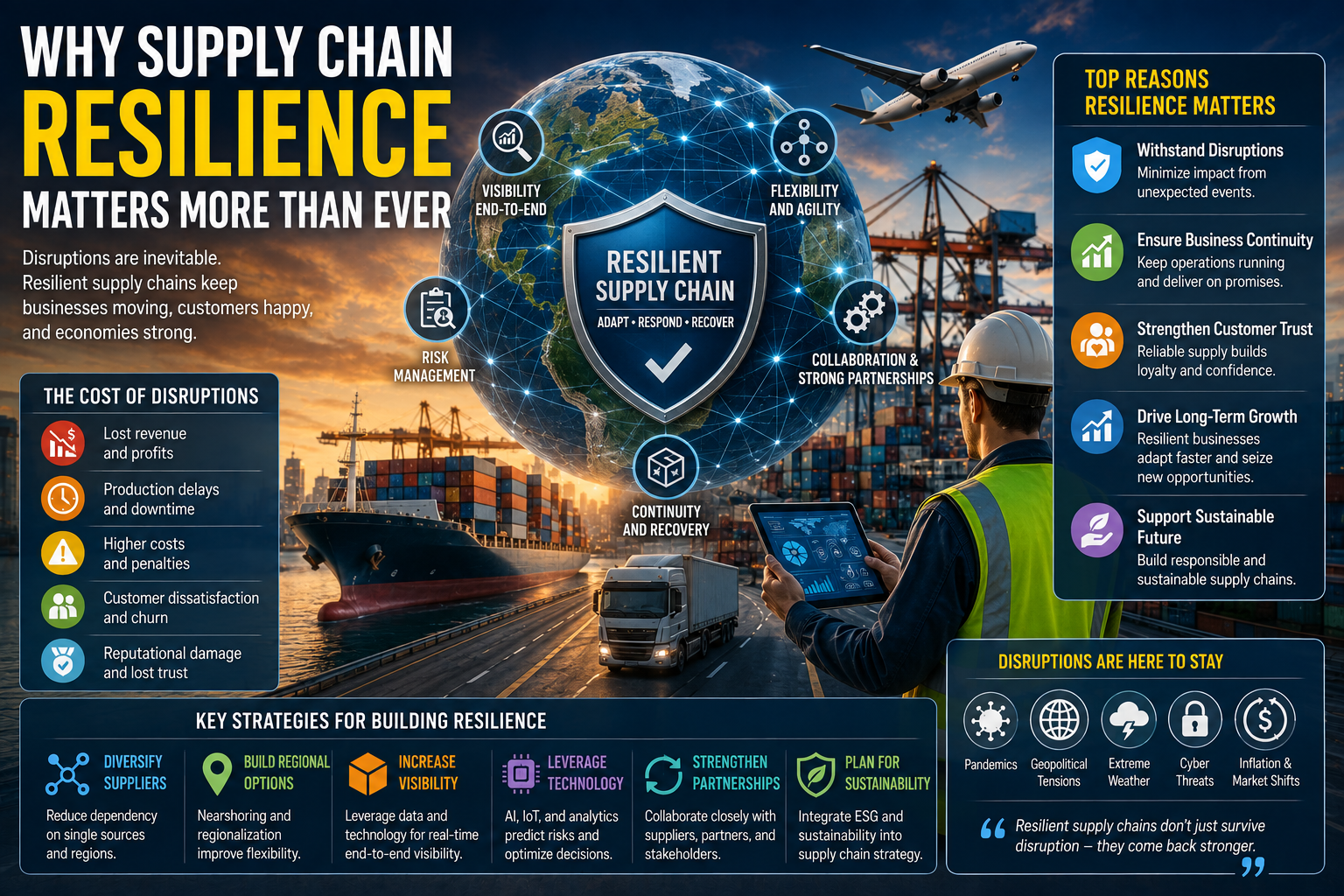
The Cost of Supply Chain Disruptions
Supply chain disruptions can have severe financial consequences.
Potential impacts include:
- Lost sales
- Production delays
- Higher operating costs
- Inventory shortages
- Customer dissatisfaction
- Reputational damage
When critical materials become unavailable, businesses may be forced to slow or halt production entirely.
Retailers may face empty shelves, manufacturers may miss delivery deadlines, and customers may turn to competitors.
The financial impact often extends far beyond the immediate disruption itself.
Companies with weak supply chain resilience frequently experience reduced profitability and lower long-term competitiveness.
Globalization and New Risks
Globalization has delivered enormous economic benefits.
Businesses gained access to:
- Lower production costs
- Specialized suppliers
- Larger markets
- Greater efficiency
However, globalization also increased supply chain complexity.
Many products now depend on components sourced from dozens of countries.
This interconnectedness creates vulnerabilities because disruptions in one region can affect operations worldwide.
For example, a shortage of semiconductor chips can impact automotive manufacturing, consumer electronics production, industrial equipment, and healthcare devices simultaneously.
The challenge for businesses in 2026 is maintaining the benefits of globalization while reducing associated risks.
Diversification Is Becoming Essential
One of the most important resilience strategies involves supplier diversification.
Historically, many organizations relied heavily on single suppliers or concentrated production in specific regions.
While this approach often reduced costs, it increased vulnerability.
Today, businesses increasingly diversify by:
- Working with multiple suppliers
- Expanding sourcing regions
- Developing backup production capabilities
- Establishing alternative transportation routes
Diversification helps reduce dependence on any single supplier, country, or logistics provider.
Although it may increase operational complexity, it significantly improves resilience during disruptions.
The Rise of Nearshoring and Regionalization
A major trend shaping supply chains in 2026 is regionalization.
Companies are increasingly moving production closer to key markets through strategies such as:
Nearshoring
Relocating manufacturing to nearby countries.
Reshoring
Returning production to domestic markets.
Friendshoring
Building supply networks with politically aligned countries.
These strategies offer several benefits:
- Shorter transportation times
- Reduced geopolitical risks
- Greater supply chain visibility
- Improved responsiveness
- Lower disruption exposure
While global supply chains remain important, many organizations are adopting hybrid models that combine international sourcing with regional production capabilities.
Technology Is Strengthening Resilience
Technology plays a central role in modern supply chain management.
Businesses increasingly use digital tools to improve visibility, forecasting, and decision-making.
Key technologies include:
Artificial Intelligence
AI helps predict demand, identify risks, and optimize inventory levels.
Internet of Things
Connected sensors provide real-time tracking of shipments and equipment.
Predictive Analytics
Advanced analytics identify potential disruptions before they occur.
Cloud Platforms
Digital platforms improve communication and collaboration across supply chain networks.
Digital Twins
Virtual models allow companies to simulate disruptions and test response strategies.
These technologies help organizations move from reactive crisis management to proactive risk prevention.
Inventory Strategies Are Changing
For many years, companies embraced “just in time” inventory systems designed to minimize storage costs.
While highly efficient, these systems often left businesses vulnerable to disruptions.
Today, many organizations are adopting more balanced inventory strategies.
These approaches may include:
- Maintaining safety stock
- Holding strategic reserves
- Increasing inventory visibility
- Diversifying warehouse locations
Although carrying additional inventory increases costs, it can provide valuable protection against unexpected shortages.
Businesses increasingly view inventory as a resilience tool rather than merely a cost center.
Supply Chain Visibility Has Become Critical
Visibility is one of the most important components of supply chain resilience.
Organizations cannot manage risks they cannot see.
Modern supply chains often involve:
- Multiple suppliers
- Global transportation networks
- Third-party logistics providers
- Contract manufacturers
Without visibility, disruptions can remain undetected until they affect customers.
Businesses are investing heavily in technologies that provide real-time information regarding:
- Inventory levels
- Shipment locations
- Supplier performance
- Transportation delays
- Production capacity
Improved visibility enables faster decision-making and more effective responses during disruptions.
Sustainability and Resilience Are Connected
Environmental sustainability and supply chain resilience are increasingly linked.
Climate change creates new risks that businesses must address.
Examples include:
- Extreme weather events
- Water shortages
- Energy disruptions
- Resource scarcity
Organizations that incorporate sustainability into supply chain planning often improve resilience simultaneously.
Strategies may include:
- Renewable energy adoption
- Sustainable sourcing
- Circular economy initiatives
- Resource efficiency improvements
These measures can reduce vulnerability while supporting long-term environmental goals.
Building Strong Supplier Relationships
Resilience is not solely about technology and infrastructure.
Relationships matter as well.
Strong partnerships with suppliers can improve communication, collaboration, and problem-solving during disruptions.
Leading organizations increasingly view suppliers as strategic partners rather than transactional vendors.
Benefits of strong supplier relationships include:
- Faster information sharing
- Improved flexibility
- Better coordination
- Greater trust
- Enhanced innovation
Collaboration often becomes especially important during periods of crisis.
The Role of Workforce Resilience
People remain a critical component of supply chain operations.
Labor shortages continue affecting industries such as:
- Manufacturing
- Transportation
- Warehousing
- Logistics
Organizations are investing in:
- Workforce training
- Automation
- Cross-functional skills
- Employee retention programs
A resilient workforce helps businesses maintain operations even during periods of disruption.
Human expertise remains essential despite advances in automation and artificial intelligence.
Supply Chain Resilience and Economic Growth
Resilient supply chains contribute to broader economic stability.
Strong supply networks support:
- Trade
- Manufacturing
- Consumer spending
- Employment
- Investment
When supply chains function effectively, businesses can meet demand, maintain production, and invest in growth opportunities.
Conversely, widespread disruptions can slow economic activity and contribute to inflationary pressures.
As a result, governments increasingly view supply chain resilience as a national economic priority.
Many countries are investing in infrastructure, domestic manufacturing capabilities, and strategic industries to strengthen supply chain security.
Challenges to Building Resilience
Despite its importance, building resilience presents challenges.
Higher Costs
Diversification, inventory buffers, and regional production often increase expenses.
Complexity
Managing multiple suppliers and locations requires sophisticated coordination.
Technology Investment
Digital transformation initiatives can require significant capital expenditures.
Organizational Change
Building resilience often requires cultural and strategic shifts.
Businesses must balance these challenges against the potentially greater costs of disruption.
What Businesses Should Focus On in 2026
Organizations seeking stronger supply chains should prioritize:
Risk Assessment
Identify vulnerabilities across the supply network.
Supplier Diversification
Reduce dependence on single sources.
Technology Adoption
Improve visibility and forecasting capabilities.
Scenario Planning
Prepare for potential disruptions before they occur.
Strategic Inventory Management
Balance efficiency with preparedness.
Sustainability Integration
Address environmental risks while improving resilience.
Companies that proactively invest in these areas are likely to gain long-term competitive advantages.
The Future of Supply Chain Resilience
Looking ahead, supply chains will continue evolving.
Several trends are likely to shape the future:
- Increased AI adoption
- Greater automation
- Expanded regional production networks
- Enhanced sustainability initiatives
- Improved digital visibility
- Stronger public-private collaboration
The most successful organizations will combine efficiency, flexibility, technology, and strategic planning.
Rather than eliminating risk entirely, they will focus on managing uncertainty effectively.
Conclusion
Supply chain resilience has become one of the most important business priorities in 2026. The disruptions of recent years have demonstrated that efficiency alone is no longer sufficient in an increasingly complex and unpredictable world. Businesses must build supply networks capable of adapting to changing conditions, recovering from disruptions, and supporting long-term growth.
Through supplier diversification, technology adoption, regionalization, improved visibility, and stronger partnerships, organizations can strengthen resilience while maintaining competitiveness. As global risks continue evolving, resilient supply chains will play a critical role in supporting business success, economic stability, and sustainable growth. Companies that invest in resilience today will be better prepared for the challenges and opportunities of tomorrow.