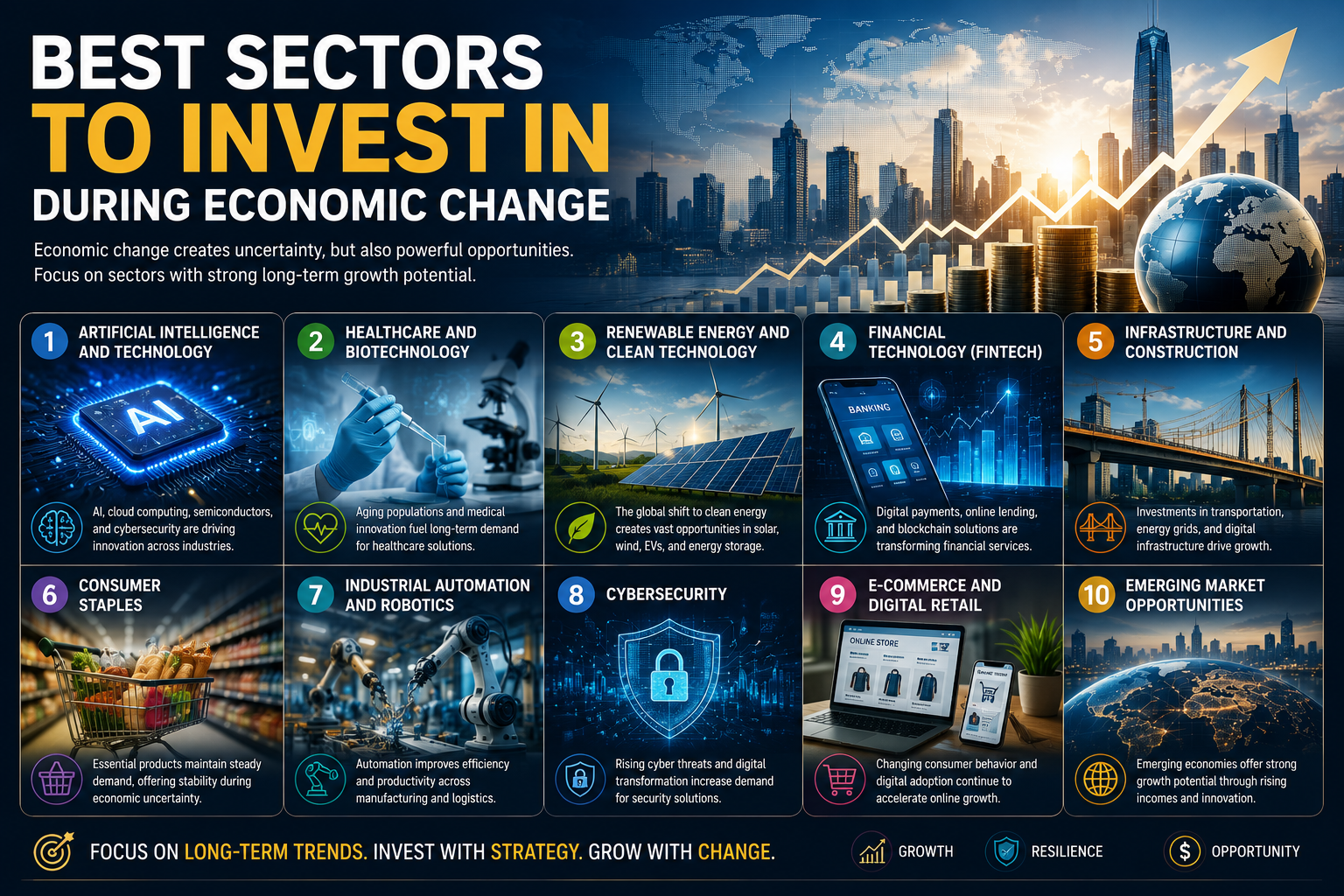
Best Sectors to Invest In During Economic Change – Economic change is a constant feature of global markets. Whether driven by technological innovation, shifting consumer behavior, inflation, interest rate movements, or geopolitical events, changing economic conditions create both challenges and opportunities for investors. While market uncertainty can be intimidating, it also opens the door to sectors that are positioned to benefit from new trends and evolving economic realities.
As the global economy moves through 2026, investors are paying close attention to industries that can deliver growth despite economic fluctuations. Understanding which sectors are likely to thrive during periods of change can help investors make more informed decisions and build resilient portfolios.
Why Economic Change Creates Investment Opportunities
Periods of economic transition often reshape industries and consumer priorities. Some sectors struggle to adapt, while others emerge as clear winners.
For example, technological revolutions have transformed the way businesses operate, creating entirely new markets. Likewise, demographic changes, environmental concerns, and shifts in government policies continue to influence where capital flows.
Successful investors recognize that economic change is not merely a risk—it is also an opportunity to identify industries with strong long-term growth potential.
The key is focusing on Best Sectors to Invest In supported by powerful structural trends rather than short-term market speculation.
1. Artificial Intelligence and Technology
Artificial intelligence remains one of the most transformative investment themes of the decade.
Companies across virtually every industry are investing heavily in AI solutions to improve productivity, automate processes, and enhance decision-making. Demand for AI-related infrastructure, software, and services continues to rise.
Several segments within the technology Best Sectors to Invest In stand out:
AI Software
Businesses increasingly rely on AI-powered applications for customer service, analytics, cybersecurity, and automation.
Cloud Computing
Cloud platforms provide the infrastructure needed to support AI development and large-scale data processing.
Semiconductors
Advanced chips remain essential for AI systems, machine learning, and data centers.
Cybersecurity
As digital transformation accelerates, organizations require stronger protection against cyber threats.
Technology companies positioned at the center of the AI ecosystem may continue benefiting from substantial investment and growing demand throughout 2026 and beyond.
2. Healthcare and Biotechnology
Healthcare has historically been one of the most resilient Best Sectors to Invest In during economic uncertainty.
Regardless of economic conditions, people continue to require medical care, pharmaceuticals, and healthcare services. This creates a relatively stable source of demand compared with more cyclical industries.
Several trends support long-term growth:
Aging Populations
Many developed countries are experiencing demographic shifts that increase demand for healthcare services.
Medical Innovation
Advances in biotechnology, personalized medicine, and gene therapies continue creating new opportunities.
Digital Health
Telemedicine, wearable devices, and AI-assisted diagnostics are transforming patient care.
Healthcare combines defensive characteristics with significant innovation potential, making it attractive during periods of economic change.
3. Renewable Energy and Clean Technology
The transition toward cleaner energy sources is creating major investment opportunities worldwide.
Governments, corporations, and consumers are increasingly focused on sustainability and reducing carbon emissions. This shift is driving investment across multiple industries.
Key areas include:
Solar Energy
Declining costs and improved efficiency continue supporting solar adoption.
Wind Power
Utility-scale wind projects remain a major component of global renewable energy strategies.
Battery Technology
Energy storage solutions are becoming increasingly important as renewable energy capacity expands.
Electric Vehicles
Growing consumer adoption is fueling demand for EV manufacturers and supporting infrastructure.
While renewable energy investments can experience short-term volatility, the long-term trend toward decarbonization remains strong.
4. Financial Technology (FinTech)
Financial services are undergoing rapid transformation.
Consumers increasingly prefer digital banking, mobile payments, and online financial services over traditional methods. FinTech companies are responding by developing innovative solutions that improve accessibility and efficiency.
Areas with strong growth potential include:
- Digital payment platforms
- Mobile banking
- Online lending
- Wealth management technology
- Blockchain-based financial solutions
The continued digitization of financial services creates opportunities for businesses capable of delivering convenient and secure experiences.
5. Infrastructure and Construction
Economic transitions often require significant investment in infrastructure.
Governments worldwide are spending billions on projects designed to modernize transportation systems, strengthen energy grids, and improve public services.
Important investment themes include:
Transportation Infrastructure
Roads, bridges, railways, and airports require ongoing upgrades.
Digital Infrastructure
Data centers, fiber networks, and telecommunications systems support economic growth.
Energy Infrastructure
Modern energy systems require investments in generation, storage, and distribution capabilities.
Infrastructure spending can provide long-term growth opportunities while benefiting from government support and public investment initiatives.
6. Consumer Staples
Consumer staples remain a reliable Best Sectors to Invest In during periods of economic uncertainty.
These companies produce essential products that people purchase regardless of economic conditions, including:
- Food and beverages
- Household products
- Personal care items
- Basic healthcare products
Because demand tends to remain stable, consumer staples often perform better than more discretionary Best Sectors to Invest In during economic slowdowns.
Investors seeking portfolio stability frequently allocate a portion of their assets to this defensive Best Sectors to Invest In.
7. Industrial Automation and Robotics
Labor shortages, rising costs, and productivity demands are accelerating the adoption of automation technologies.
Manufacturers increasingly use robotics and advanced automation systems to improve efficiency and reduce operating expenses.
Growth drivers include:
Smart Factories
Connected manufacturing environments improve productivity and reduce waste.
Warehouse Automation
E-commerce growth continues increasing demand for automated logistics solutions.
Industrial Robotics
Robots are becoming more capable, affordable, and adaptable across industries.
Automation is no longer limited to manufacturing; it is expanding into healthcare, retail, logistics, and agriculture.
8. Cybersecurity
As economies become increasingly digital, cybersecurity has become a critical investment theme.
Organizations face growing threats from cybercriminals, ransomware attacks, and data breaches. Protecting digital assets has become a business necessity rather than an optional expense.
Cybersecurity spending continues to rise because:
- Remote work remains common
- Cloud adoption is expanding
- Regulatory requirements are increasing
- Digital infrastructure is becoming more complex
Companies providing security software, identity protection, and threat detection solutions are well-positioned for continued growth.
9. E-Commerce and Digital Retail
Consumer shopping habits continue evolving.
Online retail remains a major force in the global economy, supported by improvements in logistics, digital payments, and personalized customer experiences.
Growth opportunities exist in:
Online Marketplaces
Large e-commerce platforms continue expanding globally.
Logistics and Delivery
Fast and reliable fulfillment services remain essential.
Digital Advertising
Businesses increasingly invest in online customer acquisition.
Retail Technology
AI-powered recommendations and data analytics improve shopping experiences.
Although competition is intense, digital retail remains one of the most dynamic sectors during economic change.
10. Emerging Market Opportunities
Emerging markets offer investors access to faster-growing economies and expanding consumer bases.
Countries across Asia, Latin America, and Africa continue benefiting from:
- Urbanization
- Rising incomes
- Technology adoption
- Infrastructure development
Many emerging economies are becoming important centers for manufacturing, innovation, and digital services.
While these markets may carry higher risks, they also provide significant growth potential for long-term investors.
Factors to Consider Before Investing
While identifying promising sectors is important, investors should also evaluate broader market conditions.
Key considerations include:
Interest Rates
Higher rates can affect borrowing costs and corporate profitability.
Inflation
Persistent inflation may influence consumer spending and business expenses.
Economic Growth
Sector performance often depends on the strength of overall economic activity.
Valuation
Even great industries can become poor investments if prices become excessively high.
Diversification
Spreading investments across multiple sectors helps reduce risk.
Successful investing requires balancing growth opportunities with prudent risk management.
Conclusion- Best Sectors to Invest In
Economic change creates uncertainty, but it also creates opportunities for investors willing to focus on long-term trends. In 2026, sectors such as artificial intelligence, healthcare, renewable energy, fintech, infrastructure, cybersecurity, and automation appear particularly well-positioned for growth.
At the same time, defensive industries like consumer staples can provide stability during periods of market volatility. Emerging markets and digital retail continue offering compelling opportunities for investors seeking higher growth potential.
Rather than attempting to predict every market movement, investors may benefit from focusing on industries supported by powerful structural forces. By maintaining a diversified portfolio and staying aligned with long-term economic trends, investors can better navigate changing market conditions and position themselves for future success.