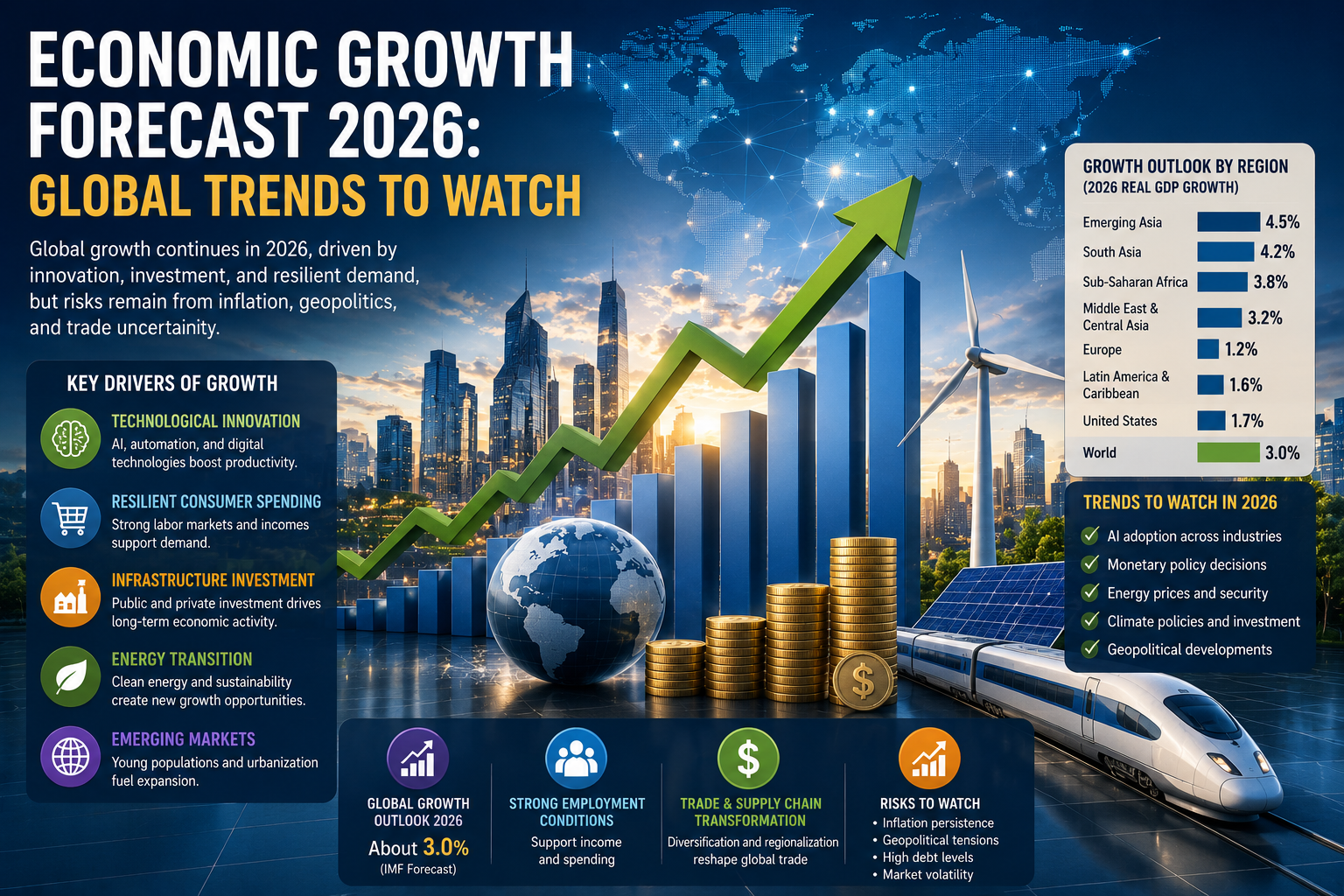
Economic Growth Forecast 2026: Global Trends to Watch – Economic growth remains one of the most closely monitored indicators of global prosperity. In 2026, governments, businesses, investors, and consumers are paying close attention to economic forecasts as they navigate a world shaped by technological innovation, geopolitical uncertainty, inflation challenges, and evolving trade relationships.
After years of economic disruptions caused by pandemics, inflation shocks, supply chain disruptions, and geopolitical conflicts, the global economy has entered a new phase. Growth continues, but the pace varies significantly across regions and industries. While some economies are benefiting from investments in technology and infrastructure, others face challenges from high debt levels, demographic shifts, and slower productivity growth.
Understanding the economic growth outlook for 2026 is essential for identifying opportunities and preparing for potential risks in an increasingly complex global economy.
The Global Growth Outlook
The global economy is expected to continue expanding in 2026, although growth remains uneven across countries and regions.
International organizations such as the International Monetary Fund (IMF) and the Organisation for Economic Co-operation and Development (OECD) project moderate global growth supported by resilient labor markets, technological innovation, and continued consumer spending. However, persistent inflation, trade tensions, and geopolitical risks continue to create uncertainty. Recent IMF forecasts suggest global growth will remain positive despite these challenges.
Unlike previous economic cycles, growth in 2026 is increasingly influenced by structural factors such as artificial intelligence, digital transformation, energy transition investments, and shifting supply chains.
These long-term trends are reshaping economic opportunities around the world.
Artificial Intelligence as a Growth Driver
One of the most significant trends supporting economic growth in 2026 is the rapid adoption of artificial intelligence.
Businesses are investing heavily in:
- AI-powered software
- Cloud computing infrastructure
- Data centers
- Semiconductor manufacturing
- Automation technologies
Many economists believe AI has the potential to increase productivity across multiple industries, helping companies produce more output with fewer resources.
Productivity growth is particularly important because it can support economic expansion without creating excessive inflation.
Major technology firms continue investing billions of dollars into AI infrastructure, creating new jobs, stimulating capital spending, and driving innovation throughout the broader economy.
As AI adoption spreads beyond the technology sector, its economic impact is expected to grow even further.
Inflation Remains a Key Challenge
Although inflation has moderated from the extreme highs seen earlier in the decade, it remains a major concern in 2026.
Energy costs, supply disruptions, and strong consumer demand continue contributing to price pressures in many countries. Recent IMF data indicates that global inflation has stabilized at levels above many central bank targets.
Higher inflation can slow economic growth because:
- Consumers spend more on necessities.
- Borrowing costs remain elevated.
- Business investment becomes more expensive.
- Purchasing power declines.
Central banks must carefully balance inflation control with economic growth objectives.
Their decisions regarding interest rates will remain one of the most important factors influencing economic performance throughout 2026.
Interest Rates and Monetary Policy
Monetary policy continues to play a crucial role in shaping the global economic outlook.
Many central banks raised interest rates aggressively during previous years to combat inflation. In 2026, policymakers are proceeding cautiously as they evaluate whether inflation is sufficiently under control to justify future rate cuts.
Higher interest rates influence economic activity by:
- Increasing borrowing costs
- Slowing housing markets
- Reducing business investment
- Encouraging savings
However, if inflation continues to decline, some central banks may eventually ease policy to support growth.
Financial markets are closely monitoring policy signals from major institutions, particularly the Federal Reserve, the European Central Bank, and other leading central banks.
Their decisions will have significant implications for investment, trade, and consumer spending worldwide.
Consumer Spending Remains Resilient
Consumer spending continues to be a major source of economic strength.
In many advanced economies, labor markets remain relatively healthy, supporting household incomes and spending activity.
Consumers are still spending on:
- Travel
- Entertainment
- Technology products
- Healthcare
- Housing-related services
While inflation has affected purchasing power, strong employment conditions have helped sustain demand.
Consumer confidence remains an important factor because household spending accounts for a substantial share of economic activity in many countries.
If employment conditions remain stable, consumer spending could continue supporting growth throughout 2026.
Global Trade Is Evolving
International trade remains a critical component of economic growth, but the structure of global trade is changing.
Businesses are increasingly diversifying supply chains and reducing dependence on single production locations.
Several trends are shaping global trade:
Supply Chain Diversification
Companies are expanding manufacturing operations across multiple countries to improve resilience.
Regionalization
Businesses are focusing more on regional supply networks to reduce transportation risks and geopolitical exposure.
Strategic Industries
Governments are investing heavily in sectors such as semiconductors, renewable energy, and advanced manufacturing.
Technology Competition
Competition between major economies is influencing trade policies and investment decisions.
These changes are creating new opportunities for emerging markets while reshaping traditional trade relationships.
Emerging Markets Could Drive Future Growth
Many emerging economies are expected to contribute significantly to global growth in 2026.
Countries across Asia, Latin America, the Middle East, and Africa continue benefiting from:
- Population growth
- Urbanization
- Infrastructure investment
- Expanding middle classes
- Technology adoption
India, Southeast Asia, and several African economies are attracting increasing levels of foreign investment due to favorable demographics and growing consumer markets.
While challenges remain, emerging markets may account for a growing share of global economic expansion over the coming years.
Energy Transition Investments
The transition toward cleaner energy sources is becoming a major economic growth driver.
Governments and businesses are investing heavily in:
- Renewable energy projects
- Electric vehicle infrastructure
- Battery manufacturing
- Grid modernization
- Energy storage technologies
These investments create jobs, stimulate industrial activity, and encourage technological innovation.
The energy transition is expected to remain one of the largest sources of capital investment throughout the decade.
At the same time, energy markets remain vulnerable to geopolitical disruptions and commodity price volatility, which could influence growth prospects.
Labor Market Trends
Labor markets continue playing a central role in economic performance.
Many countries are experiencing a combination of:
- Labor shortages
- Aging populations
- Skills gaps
- Technological disruption
Businesses increasingly require workers with expertise in:
- Artificial intelligence
- Data analysis
- Cybersecurity
- Advanced manufacturing
- Digital technologies
The ability to develop and attract skilled workers will become an increasingly important determinant of economic competitiveness.
Countries that successfully invest in workforce development may achieve stronger long-term growth.
Risks to Economic Growth
Despite generally positive forecasts, several risks could slow economic growth in 2026.
Persistent Inflation
Higher-than-expected inflation could force central banks to maintain restrictive policies for longer.
Geopolitical Tensions
Conflicts, trade disputes, and political instability could disrupt investment and supply chains.
High Government Debt
Many countries continue carrying elevated debt burdens that may limit future fiscal flexibility.
Financial Market Volatility
Unexpected changes in interest rates, inflation, or investor sentiment could create market instability.
Slower Productivity Gains
If technological investments fail to generate expected productivity improvements, growth could disappoint.
Monitoring these risks will remain important for businesses and investors alike.
Opportunities for Businesses and Investors
Despite the challenges, 2026 offers numerous opportunities.
Technology
Artificial intelligence, cloud computing, cybersecurity, and semiconductor industries continue attracting investment.
Infrastructure
Government spending on transportation, energy, and digital infrastructure supports economic activity.
Healthcare
Aging populations and technological innovation are driving demand for healthcare services and solutions.
Renewable Energy
The transition toward sustainable energy continues creating growth opportunities worldwide.
Emerging Markets
Rapidly developing economies offer long-term investment potential due to demographic and economic expansion.
Businesses that adapt to changing economic conditions and invest strategically may benefit significantly from these trends.
What to Watch in 2026
Several indicators will help determine the direction of global growth throughout the year:
- Inflation trends
- Interest rate decisions
- Employment data
- Consumer spending patterns
- AI investment activity
- Global trade developments
- Energy prices
- Geopolitical events
These factors will shape economic performance across industries and regions.
Investors and business leaders should monitor them closely when making strategic decisions.
Conclusion
The economic growth forecast for 2026 remains cautiously optimistic. While challenges such as inflation, geopolitical tensions, and high debt levels continue to create uncertainty, several powerful growth drivers are supporting the global economy. Artificial intelligence, digital transformation, consumer spending, infrastructure investment, and the energy transition are helping sustain expansion across many regions. Global growth is expected to continue, though at a moderate pace and with significant differences between countries and sectors.
For businesses and investors, success in 2026 will depend on understanding these evolving trends and adapting to a rapidly changing economic environment. Those who recognize emerging opportunities while managing risks effectively will be best positioned to benefit from the next phase of global economic growth.