How Nearshoring Strategy Is Reshaping Global Trade – The global trade landscape is undergoing one of the most significant transformations in decades. For much of the late twentieth and early twenty-first centuries, businesses focused on globalization as the primary strategy for reducing costs and improving efficiency. Companies built extensive supply chains that stretched across continents, sourcing materials and manufacturing products wherever costs were lowest.
However, recent disruptions—including the COVID-19 pandemic, geopolitical tensions, trade disputes, transportation bottlenecks, labor shortages, and rising logistics costs—have exposed the vulnerabilities of highly dispersed supply chains. As a result, businesses are increasingly adopting a strategy known as nearshoring.
Nearshoring involves relocating manufacturing, sourcing, or business operations closer to a company’s primary markets. Rather than producing goods on the opposite side of the world, firms are choosing neighboring countries or nearby regions that offer lower costs while reducing supply chain risks.
In 2026, nearshoring has become one of the most influential trends shaping global trade, investment flows, industrial development, and economic growth. As companies rethink supply chain strategies, nearshoring is creating new opportunities and challenges for businesses, governments, and investors worldwide.
Understanding Nearshoring
Nearshoring refers to the practice of moving production or business activities to countries that are geographically closer to a company’s target market.
For example:
- U.S. companies may relocate manufacturing from Asia to Mexico.
- European firms may expand operations in Eastern Europe.
- Japanese companies may invest more heavily in Southeast Asian countries.
- Businesses may shift suppliers from distant regions to neighboring economies.
The primary goal is to balance cost efficiency with greater operational flexibility and resilience.
Unlike reshoring, which brings production back to the home country, nearshoring maintains international operations while reducing geographic distance.
This approach allows businesses to benefit from competitive labor costs while minimizing many of the risks associated with long global supply chains.
Why Nearshoring Has Gained Momentum
Several powerful forces have accelerated nearshoring adoption.
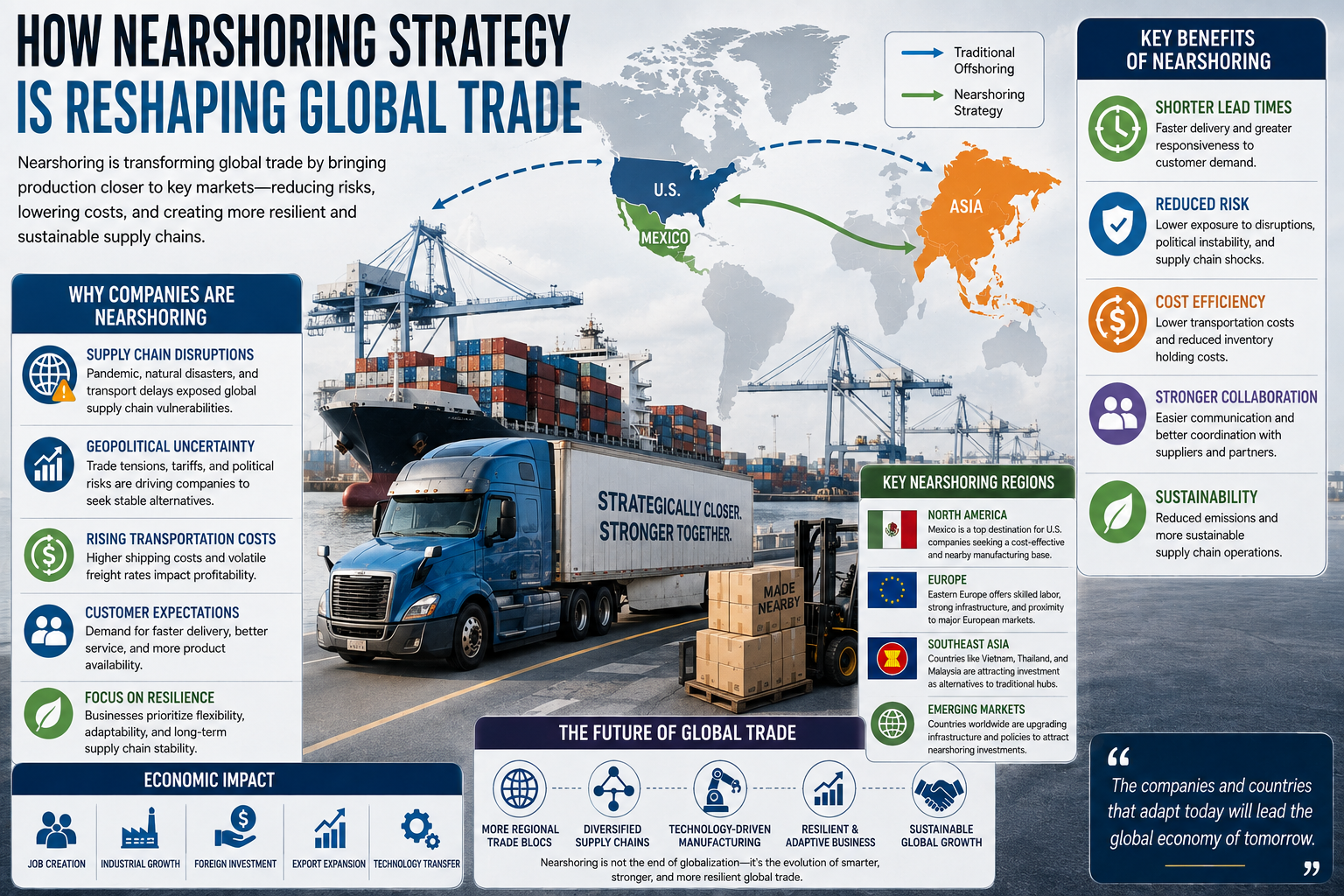
Supply Chain Disruptions
The pandemic highlighted how fragile global supply chains can be.
Factory shutdowns, shipping delays, and shortages of critical components disrupted industries worldwide.
Many companies discovered that dependence on distant suppliers created significant operational risks.
Geopolitical Tensions
Trade disputes and geopolitical competition have increased uncertainty in global commerce.
Businesses increasingly seek to reduce exposure to political risks, tariffs, sanctions, and regulatory changes.
Rising Transportation Costs
Shipping expenses have become more volatile in recent years.
Long-distance transportation increases costs, delivery times, and vulnerability to disruptions.
Customer Expectations
Consumers increasingly expect faster delivery times and greater product availability.
Nearshoring enables businesses to respond more quickly to changing market demands.
Sustainability Goals
Reducing transportation distances can lower carbon emissions and support corporate sustainability objectives.
These factors have transformed nearshoring from a niche strategy into a mainstream business priority.
The Shift from Efficiency to Resilience
For decades, global supply chains prioritized efficiency above all else.
Companies focused on:
- Lower labor costs
- Economies of scale
- Lean inventory systems
- Just-in-time production
While these strategies often improved profitability, they also created vulnerabilities.
Recent disruptions demonstrated that supply chains optimized solely for efficiency may struggle during crises.
As a result, businesses are increasingly emphasizing resilience.
Resilience involves the ability to:
- Adapt to disruptions
- Maintain operations
- Recover quickly
- Manage uncertainty
Nearshoring supports these objectives by reducing supply chain complexity and shortening the distance between production facilities and end markets.
How Nearshoring Is Reshaping Global Trade
The rise of nearshoring is changing global trade patterns in several important ways.
Regional Trade Growth
Trade is becoming increasingly regionalized.
Rather than relying exclusively on global networks, businesses are building stronger regional supply chains.
This trend supports greater economic integration among neighboring countries.
Diversified Supply Networks
Companies are reducing dependence on single production hubs.
Manufacturing is becoming more geographically distributed.
Increased Cross-Border Investment
Nearshoring drives foreign direct investment as companies establish new facilities in strategic locations.
Shorter Supply Chains
Regional production networks reduce transportation distances and lead times.
These shifts are creating a more balanced and resilient global trading system.
Mexico Has Become a Nearshoring Leader
One of the clearest examples of nearshoring can be seen in North America.
Mexico has emerged as a major beneficiary of companies relocating production closer to the United States.
Several factors contribute to Mexico’s attractiveness:
Geographic Proximity
Mexico shares a border with the United States, reducing transportation times significantly.
Trade Agreements
The United States-Mexico-Canada Agreement provides favorable trade conditions.
Competitive Labor Costs
Manufacturing costs remain lower than in many developed economies.
Established Industrial Base
Mexico possesses extensive manufacturing expertise, particularly in automotive, electronics, and industrial sectors.
As a result, numerous companies have expanded operations in Mexico to serve North American markets more efficiently.
Europe Is Experiencing Similar Trends
Nearshoring is also reshaping European manufacturing.
Western European companies increasingly invest in:
- Poland
- Czech Republic
- Hungary
- Romania
- Slovakia
These countries offer:
- Skilled labor
- Competitive costs
- Proximity to major markets
- Strong transportation infrastructure
The result is a more integrated regional manufacturing ecosystem.
Eastern European economies benefit from increased investment, while Western European firms gain greater supply chain flexibility.
Southeast Asia Is Benefiting from Diversification
Although nearshoring often focuses on geographic proximity, businesses are also pursuing regional diversification strategies.
Many companies seeking alternatives to traditional manufacturing centers have expanded operations in:
- Vietnam
- Thailand
- Malaysia
- Indonesia
- Philippines
These countries have become increasingly important manufacturing hubs.
They offer:
- Growing industrial capabilities
- Competitive labor markets
- Strategic locations
- Expanding infrastructure
This trend contributes to broader shifts in global production networks.
The Impact on Manufacturing
Manufacturing industries are among the largest beneficiaries of nearshoring.
Key sectors include:
Automotive
Vehicle manufacturers increasingly regionalize supply chains to improve flexibility and reduce disruptions.
Electronics
Technology companies seek greater control over production and component sourcing.
Medical Equipment
Healthcare manufacturers prioritize supply security and reliability.
Consumer Goods
Companies producing household products benefit from faster delivery times and inventory management improvements.
Nearshoring enables manufacturers to respond more quickly to changing consumer preferences and market conditions.
Technology Is Supporting Nearshoring
Digital technologies play an important role in making nearshoring successful.
Businesses use:
Artificial Intelligence
AI improves demand forecasting and supply chain planning.
Automation
Robotics help offset labor cost differences between regions.
Supply Chain Analytics
Advanced data tools improve visibility and risk management.
Cloud Platforms
Digital systems enable collaboration across regional production networks.
Technology allows businesses to operate more efficient and flexible supply chains regardless of location.
This makes nearshoring economically viable for a growing number of industries.
Benefits of Nearshoring
Companies pursuing nearshoring strategies often experience multiple advantages.
Faster Delivery Times
Shorter transportation routes improve responsiveness.
Reduced Supply Chain Risk
Businesses become less vulnerable to global disruptions.
Improved Inventory Management
Shorter lead times reduce the need for excessive inventory.
Greater Flexibility
Companies can adapt more quickly to changing market conditions.
Enhanced Collaboration
Closer proximity improves communication with suppliers and partners.
Sustainability Improvements
Reduced transportation distances lower emissions.
These benefits explain why nearshoring continues gaining popularity across industries.
Challenges of Nearshoring
Despite its advantages, nearshoring also presents challenges.
Infrastructure Constraints
Some regions require additional investment in transportation and logistics infrastructure.
Labor Availability
Rapid industrial expansion can create workforce shortages.
Regulatory Differences
Companies must navigate varying legal and business environments.
Capacity Limitations
Not all regions possess sufficient manufacturing capacity to meet growing demand.
Upfront Investment Costs
Establishing new facilities and supplier relationships requires significant capital.
Businesses must carefully evaluate these factors when designing nearshoring strategies.
Economic Impact of Nearshoring
The growth of nearshoring has significant implications for economic development.
Job Creation
New manufacturing facilities generate employment opportunities.
Infrastructure Investment
Governments invest in transportation, energy, and industrial parks.
Industrial Growth
Local suppliers benefit from increased demand.
Export Expansion
Countries attracting nearshoring investment often experience stronger export performance.
Technology Transfer
International companies introduce new technologies and management practices.
These effects contribute to long-term economic growth and competitiveness.
What Governments Are Doing
Many governments actively encourage nearshoring investment.
Policy initiatives often include:
- Tax incentives
- Infrastructure development
- Workforce training programs
- Trade agreements
- Regulatory reforms
Countries competing for investment recognize nearshoring as an opportunity to strengthen industrial sectors and create jobs.
Successful policies can significantly influence investment decisions and economic outcomes.
Nearshoring and the Future of Globalization
Some observers initially viewed nearshoring as a retreat from globalization.
However, the reality is more nuanced.
Globalization is not disappearing.
Instead, it is evolving.
Businesses continue operating internationally, but they are adopting more diversified and regionally balanced supply chains.
Future global trade is likely to feature:
- Greater regional integration
- Multiple production hubs
- Increased supply chain flexibility
- Stronger resilience measures
- Enhanced digital connectivity
Nearshoring strategy represents an adaptation to a more complex and uncertain global environment rather than a rejection of international commerce.
What Investors Should Watch
Investors seeking opportunities related to nearshoring should monitor:
Industrial Real Estate
Demand for manufacturing facilities and logistics centers continues growing.
Transportation Infrastructure
Ports, railways, highways, and distribution networks benefit from increased trade activity.
Manufacturing Companies
Businesses expanding regional production may gain competitive advantages.
Automation Providers
Technology firms supporting modern manufacturing remain well positioned.
Emerging Industrial Markets
Countries attracting significant nearshoring strategy investment may experience stronger economic growth.
Understanding these trends can help investors identify sectors likely to benefit from evolving trade patterns.
Conclusion
Nearshoring strategy is reshaping global trade by helping businesses build more resilient, flexible, and efficient supply chains. Driven by supply chain disruptions, geopolitical uncertainty, rising transportation costs, and changing consumer expectations, companies are increasingly relocating production closer to key markets. This shift is transforming manufacturing, investment flows, trade relationships, and economic development across multiple regions.
While challenges remain, the benefits of nearshoring—including faster delivery, reduced risk, improved flexibility, and enhanced sustainability—make it an attractive strategy for businesses navigating an increasingly complex global economy. As regional supply chains continue expanding, nearshoring will remain one of the most important forces influencing global trade and economic growth throughout 2026 and beyond.