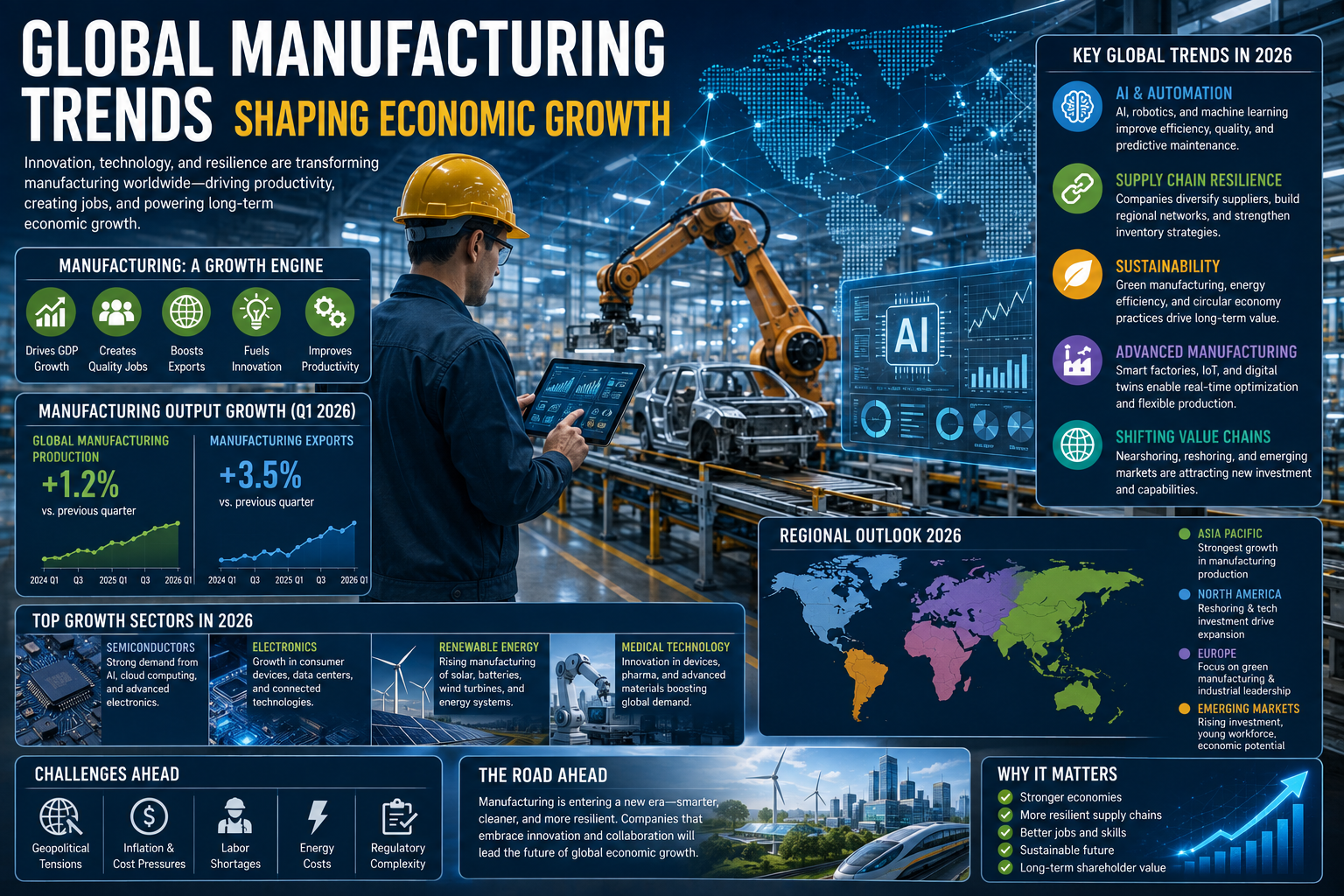
Global Manufacturing Trends Shaping Economic Growth – Manufacturing remains one of the most important pillars of the global economy. From automobiles and electronics to pharmaceuticals and industrial machinery, manufacturing drives innovation, trade, employment, and productivity. In 2026, the manufacturing sector is undergoing significant transformation as businesses adapt to artificial intelligence, automation, supply chain restructuring, sustainability goals, and shifting geopolitical realities.
While the manufacturing landscape has faced challenges from inflation, trade tensions, and regional conflicts, it continues to play a central role in supporting global economic growth. Countries that successfully modernize their manufacturing sectors are attracting investment, increasing exports, and strengthening their positions in global value chains.
As the world enters a new industrial era, understanding the latest manufacturing trends is essential for investors, business leaders, and policymakers seeking to identify opportunities and manage risks.
Manufacturing Remains a Key Driver of Growth
Despite economic uncertainty in many regions, manufacturing continues to contribute significantly to economic output, productivity, and trade.
Recent global manufacturing data shows that production growth accelerated during the first quarter of 2026, with global manufacturing output increasing by 1.2% and manufacturing exports rising by 3.5%. Higher-technology industries performed even better, highlighting the growing importance of advanced manufacturing.
Manufacturing matters because it:
- Creates high-value jobs
- Supports innovation
- Drives exports
- Encourages investment
- Improves productivity
- Strengthens supply chains
Countries with strong manufacturing sectors often enjoy greater economic resilience and long-term growth potential.
Artificial Intelligence Is Transforming Manufacturing
One of the most important trends shaping manufacturing in 2026 is the rapid adoption of artificial intelligence.
Manufacturers increasingly use AI to:
- Optimize production schedules
- Improve quality control
- Predict equipment failures
- Manage inventory
- Reduce operational costs
- Enhance supply chain visibility
AI-powered systems analyze massive amounts of data in real time, helping companies improve efficiency and productivity.
The broader global AI boom is also driving demand for manufactured products such as semiconductors, servers, networking equipment, and advanced electronics. Countries integrated into the AI technology supply chain are benefiting from stronger industrial activity and investment.
As AI capabilities continue expanding, manufacturers are expected to achieve even greater productivity gains.
Advanced Manufacturing Is Growing Faster
Not all manufacturing industries are growing at the same pace.
Higher-technology sectors continue outperforming traditional industries.
According to UNIDO, high-tech manufacturing production increased faster than lower-technology industries during 2026, while exports of advanced manufactured goods also expanded more rapidly.
Key growth areas include:
Semiconductors
AI applications are driving unprecedented demand for advanced chips.
Electronics
Consumer technology, cloud computing infrastructure, and connected devices continue supporting production growth.
Medical Technology
Healthcare innovation is creating demand for sophisticated manufacturing capabilities.
Renewable Energy Equipment
Solar panels, batteries, and energy storage systems are becoming increasingly important industrial products.
Advanced manufacturing is increasingly viewed as a strategic industry by governments worldwide.
Supply Chain Resilience Remains a Priority
Recent years exposed vulnerabilities in global supply chains.
As a result, companies continue focusing on resilience rather than simply minimizing costs.
Manufacturers are implementing several strategies:
Supplier Diversification
Businesses are reducing dependence on single suppliers and regions.
Inventory Management
Companies are maintaining larger safety stocks of critical components.
Regional Production
Manufacturers are expanding production closer to key markets.
Digital Supply Chains
Technology is improving visibility across production networks.
Supply chain resilience has become a competitive advantage, helping businesses maintain operations during disruptions.
This trend is also influencing investment decisions and manufacturing location strategies worldwide.
The Reconfiguration of Global Value Chains
Global manufacturing networks are changing significantly.
For decades, companies concentrated production in regions offering the lowest costs.
Today, factors such as geopolitical tensions, trade policies, and national security concerns are encouraging businesses to reconsider manufacturing locations.
According to UNIDO, the reconfiguration of global value chains remains one of the most important megatrends shaping industrial development. East Asia continues to play a leading role, but growing manufacturing capabilities in South Asia, Africa, and other emerging regions are gradually changing global production patterns.
This shift creates opportunities for countries seeking to attract industrial investment and strengthen their manufacturing sectors.
China Continues to Influence Global Manufacturing
China remains one of the most important manufacturing economies in the world.
Although domestic demand has weakened in some sectors, Chinese manufacturers continue expanding internationally through exports and overseas investments.
Recent data shows that Chinese vehicle exports have grown rapidly, supported by strengths in electric vehicles, batteries, and advanced manufacturing technologies. Chinese firms are increasingly building production facilities abroad while maintaining significant advantages in supply chain integration and manufacturing scale.
China’s manufacturing influence extends beyond automobiles to electronics, renewable energy equipment, industrial machinery, and numerous other sectors.
As global manufacturing evolves, China’s role remains central to international supply chains.
Sustainability Is Reshaping Industrial Strategy
Environmental sustainability has become a major factor influencing manufacturing decisions.
Governments, investors, and consumers increasingly expect businesses to reduce emissions and improve environmental performance.
Manufacturers are responding through:
- Energy-efficient production systems
- Renewable energy adoption
- Sustainable materials
- Circular economy practices
- Waste reduction initiatives
The transition toward cleaner energy is creating new manufacturing opportunities while also requiring significant investment.
Industries involved in batteries, electric vehicles, renewable energy equipment, and energy storage technologies are experiencing particularly strong growth.
Sustainability is no longer viewed solely as a regulatory requirement; it is becoming a source of competitive advantage.
Automation and Smart Factories
Automation continues transforming manufacturing operations.
Modern factories increasingly rely on:
- Industrial robots
- Machine learning systems
- Internet of Things sensors
- Digital twins
- Predictive analytics
These technologies enable manufacturers to improve productivity while maintaining consistent quality standards.
Smart factories can identify inefficiencies, optimize production flows, and respond quickly to changing market conditions.
As labor shortages affect many regions, automation is helping businesses maintain competitiveness without relying solely on workforce expansion.
The combination of automation and AI represents one of the most significant developments in modern manufacturing.
Regional Manufacturing Trends
Manufacturing growth varies considerably across regions.
Asia and the Pacific
Asia remains the strongest manufacturing region globally.
UNIDO reports that Asia and the Pacific recorded the strongest manufacturing production growth during the first quarter of 2026.
The region benefits from:
- Strong technology sectors
- Integrated supply chains
- Growing domestic markets
- Significant industrial investment
North America
Manufacturing activity has strengthened due to infrastructure spending, reshoring initiatives, and technology investment.
Recent PMI data indicates that North America has experienced one of the strongest manufacturing growth spurts in 2026.
Europe
European manufacturers continue facing challenges related to energy costs, slower economic growth, and geopolitical uncertainty.
However, advanced manufacturing capabilities remain a competitive strength.
Emerging Markets
Countries in South Asia, Africa, and Latin America are attracting increasing manufacturing investment as companies diversify production locations.
These regions may play a larger role in global manufacturing during the coming decade.
Manufacturing and Trade Are Closely Connected
Global manufacturing and international trade remain deeply interconnected.
The IMF expects global trade growth to moderate compared with previous years but notes that technology-related trade flows continue expanding rapidly. AI-driven demand is helping support industrial activity in countries integrated into global technology supply chains.
Manufacturing exports remain a critical source of growth for many economies.
Trade allows manufacturers to:
- Access larger markets
- Achieve economies of scale
- Improve competitiveness
- Expand investment opportunities
Despite ongoing trade tensions, international manufacturing networks continue evolving rather than disappearing.
Challenges Facing Global Manufacturing
Although the outlook remains generally positive, manufacturers face several challenges.
Geopolitical Tensions
Conflicts and trade disputes continue creating uncertainty.
Inflationary Pressures
Higher input costs can reduce profitability.
Labor Shortages
Many regions face difficulties attracting skilled workers.
Energy Costs
Manufacturing remains sensitive to fluctuations in energy prices.
Regulatory Complexity
Environmental and trade regulations require ongoing adaptation.
Successfully managing these challenges will be essential for sustaining future growth.
Manufacturing and Economic Productivity
One reason manufacturing remains so important is its contribution to productivity growth.
Manufacturing industries often:
- Invest heavily in technology
- Generate innovation
- Improve workforce skills
- Encourage capital investment
The World Economic Forum identifies advanced manufacturing, AI adoption, and digital transformation as major drivers of future economic growth. These trends are expected to increase productivity and support long-term expansion despite broader economic challenges.
Productivity improvements help economies grow without generating excessive inflation, making manufacturing a crucial component of sustainable development.
What Businesses and Investors Should Watch
Several trends are likely to shape manufacturing throughout the remainder of 2026 and beyond:
- AI adoption in industrial operations
- Semiconductor demand growth
- Supply chain diversification
- Renewable energy manufacturing
- Automation investments
- Industrial reshoring and nearshoring
- Advanced materials development
- Global trade policy changes
Businesses that adapt to these trends may achieve stronger growth and greater competitiveness.
Investors can also benefit by identifying companies positioned to capitalize on industrial transformation.
Conclusion
Global manufacturing remains one of the most powerful forces driving economic growth in 2026. Despite geopolitical uncertainty, inflation pressures, and evolving trade dynamics, the sector continues expanding through technological innovation, AI adoption, automation, and supply chain modernization. Advanced manufacturing industries, particularly those connected to semiconductors, artificial intelligence, renewable energy, and digital infrastructure, are leading the next phase of industrial growth.
As manufacturing becomes increasingly technology-driven, countries and companies that invest in innovation, workforce development, and industrial resilience will be best positioned to succeed. The future of economic growth is closely linked to the future of manufacturing, making this sector one of the most important areas to watch in the years ahead.
This content is sponsored by: https://ez96official.com/.