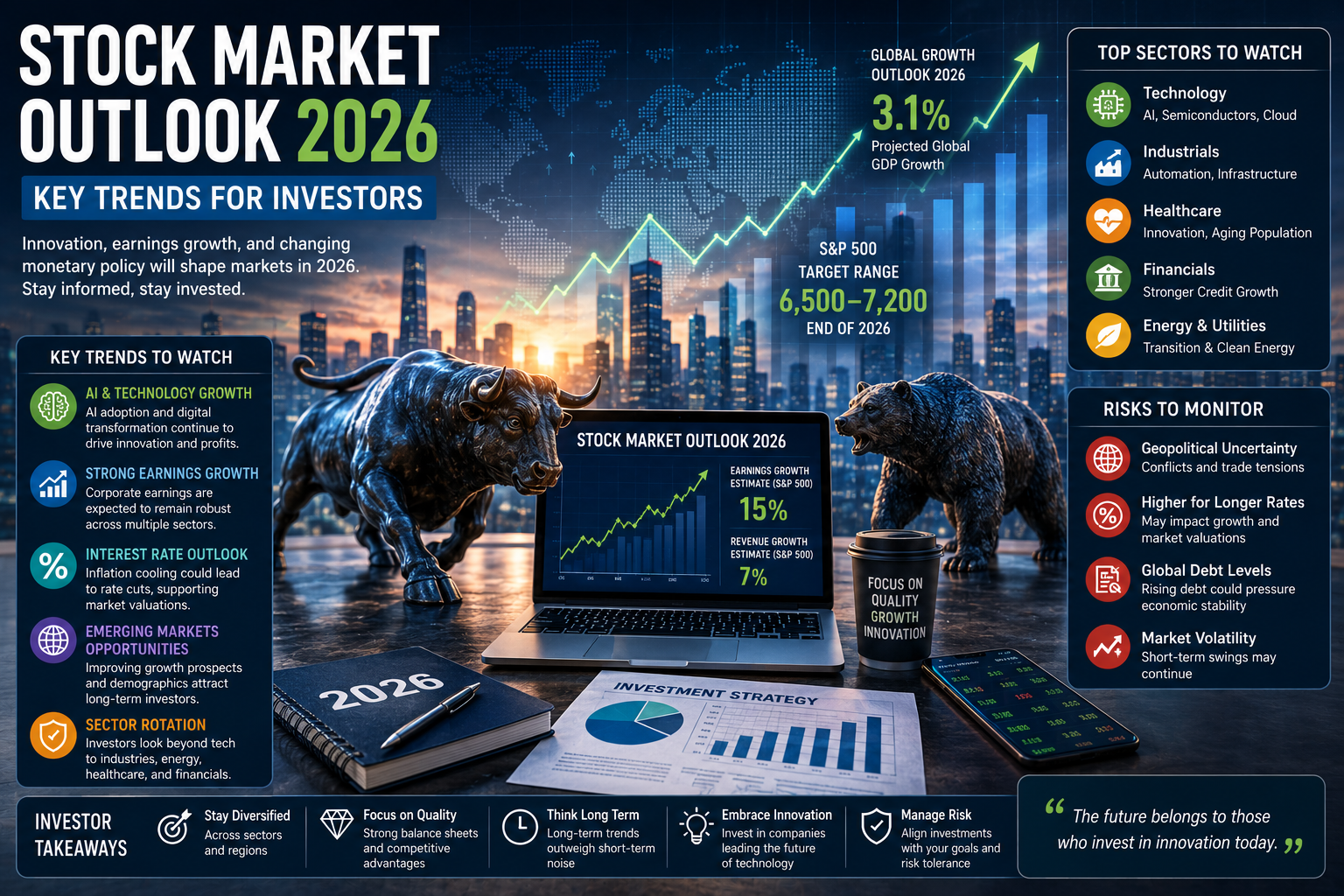
Stock Market Outlook 2026 Key Trends for Investors – The global stock market enters 2026 amid a unique mix of optimism and uncertainty. Artificial intelligence continues to drive corporate investment, central banks are navigating inflation and interest rate decisions, and geopolitical developments remain capable of influencing investor sentiment at any moment. Despite these challenges, many major stock indexes have delivered strong performance, supported by resilient corporate earnings and expectations of continued technological innovation.
For investors, understanding the stock market outlook in 2026 requires looking beyond short-term headlines and focusing on the broader trends shaping global markets. From AI-driven growth and changing monetary policy to sector rotation and emerging market opportunities, several key forces are influencing investment strategies this year.
While no forecast can perfectly predict market movements, recognizing these trends can help investors make more informed decisions and better position their portfolios for the future.
The Market Environment in 2026
The investment landscape in 2026 differs significantly from the environment that existed just a few years ago.
Following periods of elevated inflation and aggressive interest rate increases, investors are now assessing how economies will perform as inflation gradually moderates. Economic growth remains positive in many regions, although the pace varies among countries.
At the same time, corporate profits continue expanding, supported by productivity improvements, technology investments, and resilient consumer spending.
Several factors are contributing to market confidence:
- Strong corporate earnings
- Continued AI investment
- Stable labor markets
- Improving inflation trends
- Ongoing infrastructure spending
However, risks remain, including geopolitical tensions, government debt concerns, and uncertainty regarding future central bank actions.
This combination of opportunities and risks creates a dynamic environment for investors.
Artificial Intelligence Remains the Biggest Market Driver
No trend is having a larger impact on stock markets in 2026 than artificial intelligence.
Companies are investing heavily in:
- AI software
- Cloud computing
- Data centers
- Semiconductor manufacturing
- Automation technologies
The AI boom has created significant opportunities across multiple sectors.
Technology companies continue benefiting from increased demand for advanced computing power and AI-enabled services. Meanwhile, businesses in healthcare, finance, manufacturing, and logistics are using AI to improve productivity and reduce costs.
Investors increasingly view AI as a long-term growth catalyst rather than a temporary trend.
The economic implications are substantial because AI has the potential to boost productivity, enhance profitability, and create entirely new markets.
As adoption expands, AI-related investments are expected to remain one of the strongest drivers of market performance.
Corporate Earnings Continue Supporting Markets
Corporate earnings remain a critical factor in determining stock market direction.
Strong earnings growth often signals healthy economic conditions and supports higher equity valuations.
In 2026, many companies continue reporting solid financial results due to:
- Revenue growth
- Operational efficiency improvements
- Productivity gains
- Cost management initiatives
- Technology investments
Technology firms remain among the strongest contributors to earnings growth, but positive trends are increasingly spreading across industrials, healthcare, financial services, and consumer sectors.
This broader earnings participation is important because it suggests economic strength is not limited to a small group of companies.
When earnings growth becomes more diversified, markets often become more resilient.
Interest Rates and Monetary Policy
Central bank decisions remain one of the most important influences on stock markets.
After years of inflation concerns, investors are closely watching monetary policy developments.
Interest rates affect markets in several ways:
Valuation Impact
Lower rates generally support higher stock valuations because future earnings become more valuable when discounted at lower rates.
Borrowing Costs
Companies benefit when financing becomes less expensive.
Consumer Spending
Lower borrowing costs can stimulate demand for goods and services.
Investor Behavior
Interest rate changes influence how investors allocate capital between stocks, bonds, and cash.
If inflation continues moderating during 2026, investors may become increasingly optimistic about future monetary policy conditions.
However, unexpected inflation pressures could create volatility and alter market expectations.
Technology Remains a Leading Sector
Technology continues to dominate market discussions.
The sector benefits from several powerful trends:
Artificial Intelligence
AI infrastructure and software spending remain major growth drivers.
Cloud Computing
Businesses continue migrating operations to cloud-based platforms.
Cybersecurity
Growing digital threats are increasing demand for security solutions, stock market outlook.
Semiconductor Expansion
AI-related computing requirements are fueling semiconductor investment.
Technology companies often command premium valuations because investors expect higher growth rates.
While this creates opportunities, it also means investors must carefully evaluate whether expectations remain realistic.
Nevertheless, technology is likely to remain a major contributor to market performance throughout 2026.
Sector Rotation Is Creating Opportunities
Although technology attracts much attention, other sectors are also showing strength.
Investors increasingly focus on opportunities beyond large-cap technology stocks.
Industrials
Infrastructure spending, manufacturing investment, and automation trends support industrial companies.
Healthcare
Demographic changes and medical innovation continue driving long-term growth.
Financial Services
Banks and financial institutions may benefit from stable economic conditions and improved lending activity.
Energy
Energy companies continue generating profits while balancing traditional operations with renewable energy investments, stock market outlook.
Consumer Discretionary
Strong labor markets and resilient spending support consumer-focused businesses.
Sector diversification remains important because leadership often changes as economic conditions evolve.
The Rise of AI Infrastructure Stocks
One of the most significant investment themes of 2026 involves AI infrastructure.
The AI ecosystem requires enormous amounts of physical infrastructure, including:
- Data centers
- Advanced chips
- Networking equipment
- Energy resources
- Cloud computing facilities
As a result, investors are increasingly looking beyond software companies.
Businesses involved in building and supporting AI infrastructure have become major beneficiaries of the technology boom.
This trend has expanded investment opportunities across multiple industries.
Companies supplying hardware, construction services, power systems, and specialized equipment are experiencing increased demand.
The AI revolution is therefore influencing a much broader portion of the market than many investors initially expected.
Emerging Markets Are Gaining Attention
Emerging markets are becoming increasingly attractive to global investors.
Several factors support this trend:
- Population growth
- Urbanization
- Technology adoption
- Expanding middle classes
- Infrastructure development
Countries in Asia, Latin America, the Middle East, and Africa continue attracting investment capital due to favorable demographic and economic conditions.
While emerging markets often experience greater volatility, they can also provide higher growth potential than mature economies.
Investors seeking diversification may find opportunities in regions benefiting from long-term structural growth trends.
Geopolitical Risks Remain Important
Geopolitical developments continue influencing market sentiment.
Key concerns include:
Trade Relations
Changes in trade policies can affect global supply chains and corporate profitability.
Regional Conflicts
Military conflicts can disrupt energy markets and investor confidence.
Economic Competition
Competition among major economies influences technology investment and industrial policy.
Regulatory Changes
Governments increasingly shape markets through legislation and strategic investment programs.
Although markets often adapt to geopolitical uncertainty, unexpected events can create periods of heightened volatility.
Investors should remain aware of these risks while maintaining a long-term perspective.
The Growing Importance of Productivity
Productivity growth is becoming a major investment theme.
Historically, periods of strong productivity improvement have supported:
- Economic expansion
- Corporate profit growth
- Rising wages
- Higher stock market returns
Artificial intelligence is widely viewed as a potential catalyst for a new productivity cycle.
Businesses that successfully integrate AI and automation technologies may achieve:
- Lower operating costs
- Faster innovation
- Greater profitability
- Improved competitive positioning
Investors increasingly evaluate companies based on their ability to leverage productivity-enhancing technologies.
This trend is likely to become even more important during the coming years.
Valuation Concerns and Market Risks
While the outlook remains generally positive, investors should also consider potential risks.
Elevated Valuations
Some sectors trade at historically high valuation levels.
Inflation Surprises
Unexpected inflation increases could affect interest rate expectations.
Economic Slowdowns
Weaker growth could reduce earnings forecasts.
Government Debt
Rising sovereign debt levels may create financial market uncertainty.
Market Concentration
A significant portion of market gains has been driven by a relatively small number of large companies.
These risks do not necessarily indicate a market downturn, but they highlight the importance of diversification and risk management.
Strategies for Investors in 2026
Given current conditions, investors may benefit from focusing on several principles.
Diversification
Maintaining exposure across sectors and regions can reduce portfolio risk.
Quality Companies
Businesses with strong balance sheets and consistent earnings growth often perform well during uncertain periods.
Long-Term Perspective
Short-term volatility should not distract from long-term investment objectives.
Technology Exposure
AI and digital transformation remain important growth themes.
Risk Management
Investors should align portfolios with their risk tolerance and financial goals.
Successful investing often depends more on discipline and strategy than on attempting to predict short-term market movements.
What Investors Should Watch
Several indicators will provide important clues regarding market direction throughout 2026:
- Corporate earnings reports
- Inflation data
- Interest rate decisions
- Employment trends
- Consumer spending activity
- AI investment levels
- Economic growth forecasts
- Geopolitical developments
Monitoring these factors can help investors understand changing market conditions and identify emerging opportunities.
Conclusion
The stock market outlook for 2026 remains broadly constructive, supported by strong corporate earnings, continued artificial intelligence investment, resilient economic growth, and improving productivity trends. While challenges such as inflation uncertainty, geopolitical tensions, and valuation concerns remain, the overall environment continues to provide meaningful opportunities for long-term investors.
Artificial intelligence stands at the center of many market trends, influencing everything from technology stocks and infrastructure investments to productivity growth and corporate profitability. At the same time, opportunities are expanding across sectors such as industrials, healthcare, energy, and emerging markets.
For investors, success in 2026 will likely depend on maintaining a balanced perspective—recognizing both the transformative opportunities driving market growth and the risks that can create short-term volatility. Those who remain focused on quality investments, diversification, and long-term trends may be best positioned to benefit from the evolving global market landscape.