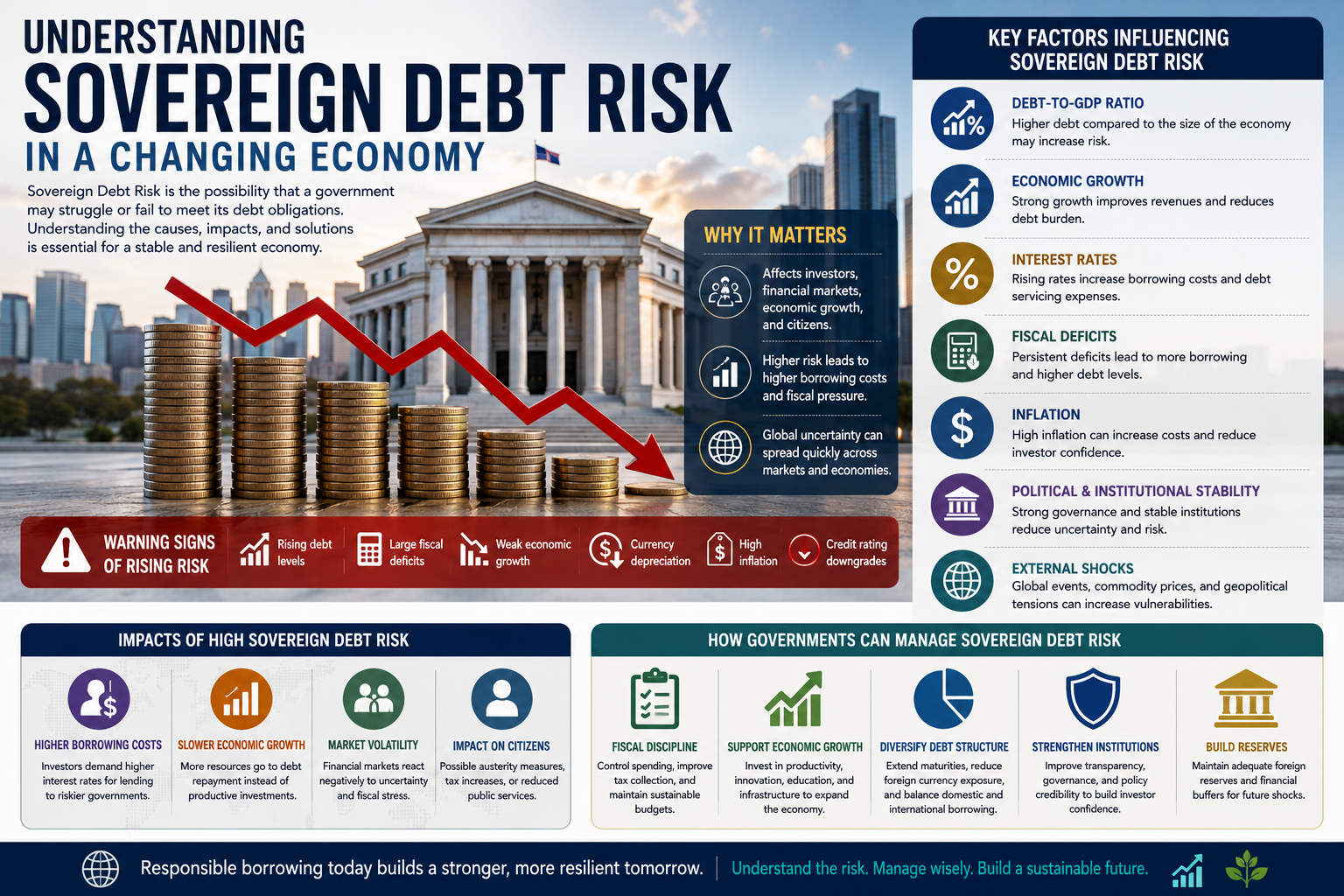
Understanding Sovereign Debt Risk in a Changing Economy – In today’s interconnected global economy, governments regularly borrow money to fund public services, infrastructure projects, social programs, and economic development initiatives. While borrowing can support growth and stability, excessive debt can create significant financial challenges. This is where Sovereign Debt Risk becomes an important concept for investors, policymakers, businesses, and citizens alike.
As economic conditions evolve due to inflation, interest rate changes, geopolitical tensions, demographic shifts, and technological transformation, understanding Sovereign Debt Risk has become more critical than ever. Countries around the world are facing increasing pressure to balance economic growth with fiscal responsibility while managing rising debt burdens.
This article explores what Sovereign Debt Risk means, why it matters, the factors that influence it, and how governments can reduce financial vulnerabilities in an increasingly complex economic environment.
What Is Sovereign Debt Risk?
Sovereign Debt Risk refers to the possibility that a national government may struggle or fail to meet its debt obligations. These obligations typically include interest payments and repayment of borrowed funds owed to domestic or international lenders.
Governments issue bonds and other debt instruments to raise capital. Investors who purchase these bonds expect timely payments according to agreed terms. When concerns arise about a government’s ability to fulfill these obligations, Sovereign Debt Risk increases.
Unlike corporations, sovereign nations have unique financial powers, including taxation authority and monetary policy tools. However, these advantages do not eliminate the possibility of debt distress or default.
Why Governments Borrow Money
Government borrowing is a normal part of economic management.
Countries often borrow to:
- Build infrastructure
- Fund healthcare systems
- Support education programs
- Invest in transportation networks
- Respond to economic crises
- Finance military and security needs
- Stimulate growth during recessions
Borrowing can be beneficial when debt supports productive investments that generate future economic growth. Problems arise when debt grows faster than a country’s ability to manage or repay it.
This is when Sovereign Debt Risk begins attracting greater attention from investors and financial markets.
Why Sovereign Debt Risk Matters
The consequences of rising Sovereign Debt Risk extend far beyond government finances.
Impact on Investors
Investors use sovereign bonds as a major component of portfolios.
When Sovereign Debt Risk increases, investors may demand higher interest rates to compensate for the possibility of losses. This raises borrowing costs for governments and can affect investment returns.
Impact on Economic Growth
High debt levels can limit a government’s ability to invest in economic development.
As debt servicing costs increase, fewer resources remain available for:
- Infrastructure projects
- Healthcare improvements
- Education initiatives
- Innovation programs
Reduced public investment may slow long-term economic growth.
Impact on Financial Markets
Sovereign debt concerns can create volatility across global markets.
Government bonds are often viewed as benchmark assets. Rising Sovereign Debt Risk may influence:
- Currency values
- Equity markets
- Banking stability
- International investment flows
Financial uncertainty can spread quickly through interconnected economies.
Impact on Citizens
Ultimately, citizens often bear the consequences of fiscal instability.
Governments facing elevated Sovereign Debt Risk may implement:
- Spending cuts
- Tax increases
- Reduced public services
- Economic austerity measures
These actions can affect employment, living standards, and social stability.
Key Factors Influencing Sovereign Debt Risk
Several factors determine the level of Sovereign Debt Risk facing a country.
Debt-to-GDP Ratio
One of the most commonly used indicators is the debt-to-GDP ratio.
This metric compares total government debt to the size of the national economy.
A higher ratio may indicate greater difficulty managing debt obligations, especially if economic growth slows.
However, there is no universal threshold that automatically signals danger. The sustainability of debt depends on multiple factors beyond the ratio itself.
Economic Growth
Strong economic growth generally reduces Sovereign Debt Risk.
Growing economies generate:
- Higher tax revenues
- Increased employment
- Greater business activity
- Improved government finances
When growth slows or contracts, governments may find it more difficult to manage existing debt burdens.
Interest Rates
Interest rates play a critical role in determining debt sustainability.
As rates rise:
- Borrowing becomes more expensive
- Debt servicing costs increase
- Budget pressures intensify
Many countries have faced higher financing costs in recent years as central banks raised interest rates to combat inflation.
Fiscal Deficits
Persistent government deficits can increase Sovereign Debt Risk over time.
When expenditures consistently exceed revenues, governments must continue borrowing to cover the gap.
Large and prolonged deficits often contribute to rising debt levels.
Inflation
Inflation can have both positive and negative effects on government debt.
Moderate inflation may reduce the real value of existing debt.
However, high inflation can:
- Increase borrowing costs
- Reduce investor confidence
- Create economic instability
Managing inflation effectively is essential for maintaining fiscal credibility.
The Role of Credit Rating Agencies
Credit rating agencies evaluate the financial health of governments and assign sovereign credit ratings.
Major agencies assess factors such as:
- Debt levels
- Economic performance
- Political stability
- Fiscal management
- Institutional strength
These ratings help investors assess Sovereign Debt Risk when making investment decisions.
A downgrade may increase borrowing costs because investors perceive higher risk.
Conversely, strong ratings often enable governments to borrow at lower interest rates.
Sovereign Debt Risk and Emerging Markets
Emerging economies often face unique challenges regarding Sovereign Debt Risk.
These countries may experience:
- Greater exposure to external shocks
- Currency volatility
- Dependence on commodity exports
- Political uncertainty
- Limited access to capital markets
Foreign currency debt can create additional vulnerabilities.
If a country’s currency weakens significantly, repaying foreign-denominated debt becomes more expensive, increasing financial stress.
As a result, investors typically pay close attention to fiscal and economic conditions in emerging markets.
Global Events That Increase Sovereign Debt Risk
Several global developments can influence sovereign debt sustainability.
Economic Recessions
Recessions often reduce government revenues while increasing public spending needs.
During downturns, governments may borrow heavily to support:
- Unemployment programs
- Business assistance
- Economic stimulus measures
While necessary, these actions can contribute to higher debt levels.
Geopolitical Tensions
Conflicts and geopolitical uncertainty can affect:
- Trade flows
- Energy prices
- Investment confidence
- Government spending priorities
Increased defense expenditures may place additional pressure on public finances.
Demographic Changes
Many developed economies face aging populations.
As populations age, governments may experience higher spending on:
- Healthcare
- Pension systems
- Social services
These long-term obligations can contribute to elevated Sovereign Debt Risk if not managed effectively.
Climate and Environmental Challenges
Climate-related disasters and environmental adaptation efforts require significant public investment.
Governments increasingly face the challenge of funding resilience projects while maintaining fiscal sustainability.
Warning Signs of Rising Sovereign Debt Risk
Investors and economists often monitor specific indicators.
Common warning signs include:
- Rapidly increasing debt levels
- Persistent budget deficits
- Weak economic growth
- High inflation
- Currency depreciation
- Political instability
- Declining foreign reserves
- Credit rating downgrades
While no single indicator guarantees a crisis, multiple warning signs may suggest rising vulnerabilities.
How Governments Manage Sovereign Debt Risk
Governments employ various strategies to reduce Sovereign Debt Risk.
Fiscal Discipline
Maintaining sustainable budgets is one of the most effective approaches.
This may involve:
- Controlling spending growth
- Improving tax collection
- Reducing unnecessary expenditures
- Prioritizing productive investments
Fiscal discipline helps strengthen long-term debt sustainability.
Supporting Economic Growth
Economic expansion improves government revenues and debt affordability.
Policies that encourage:
- Innovation
- Infrastructure investment
- Workforce development
- Business growth
can contribute to stronger fiscal outcomes.
Diversifying Debt Structures
Governments often seek to reduce risk by diversifying debt portfolios.
This may include:
- Extending debt maturities
- Reducing foreign currency exposure
- Balancing domestic and international borrowing
Diversification can improve resilience during periods of financial stress.
Strengthening Institutions
Transparent governance and strong institutions improve investor confidence.
Countries with credible fiscal frameworks often experience lower borrowing costs and reduced Sovereign Debt Risk.
The Future of Sovereign Debt Risk
The global economy continues to evolve rapidly.
Several trends are likely to shape future Sovereign Debt Risk dynamics:
- Higher long-term interest rates
- Technological transformation
- Demographic shifts
- Climate adaptation spending
- Geopolitical fragmentation
- Expanding public investment needs
Governments will need to balance competing priorities while maintaining fiscal sustainability.
Countries that successfully manage debt while promoting growth and stability are likely to attract stronger investor confidence and greater economic resilience.
Conclusion
Sovereign Debt Risk is a critical concept in modern finance and economic policy. It reflects the possibility that governments may face difficulties meeting their debt obligations, with implications for investors, financial markets, businesses, and citizens.
Factors such as debt levels, economic growth, inflation, interest rates, fiscal deficits, and political stability all influence Sovereign Debt Risk. In today’s changing economy, governments must carefully balance borrowing needs with long-term fiscal sustainability.
While debt can be a valuable tool for supporting development and economic growth, responsible management remains essential. By maintaining fiscal discipline, encouraging economic expansion, strengthening institutions, and adapting to emerging challenges, countries can reduce vulnerabilities and build more resilient economies for the future.