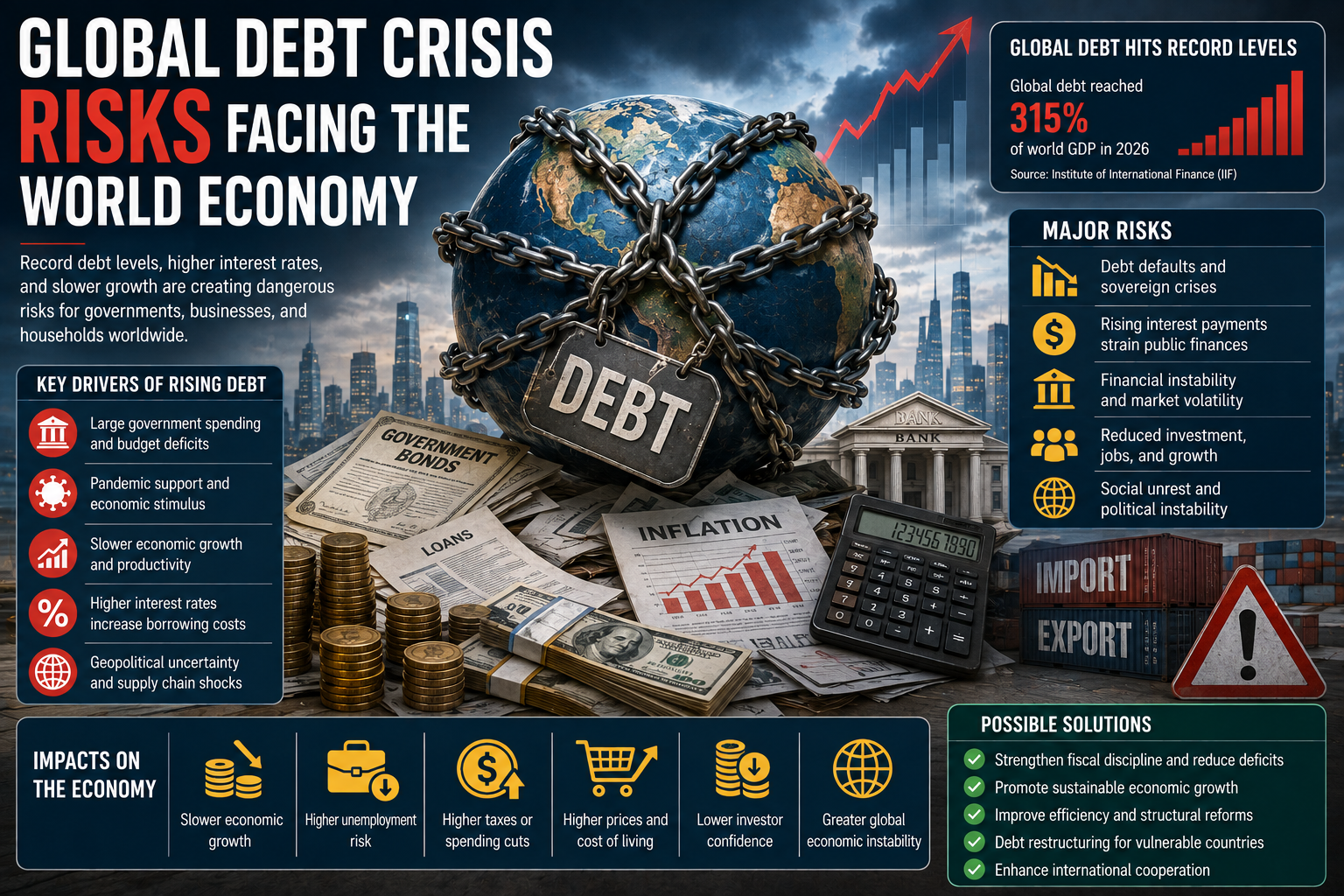
Global Debt Crisis Risks Facing the World Economy – The global economy in 2026 faces numerous challenges, but few are as significant as the growing debt burden carried by governments, businesses, and households worldwide. Over the past decade, borrowing has increased dramatically as countries responded to economic crises, pandemics, inflation shocks, geopolitical conflicts, and slowing growth. While debt can be a useful tool for financing investment and supporting economic activity, excessive debt creates vulnerabilities that can threaten long-term economic stability.
Today, global debt has reached historic levels. Governments are spending more on interest payments, corporations face higher financing costs, and many developing countries struggle to manage growing obligations. As interest rates remain elevated compared to the ultra-low-rate environment of the 2010s, concerns about debt sustainability have intensified.
Economists, policymakers, and investors increasingly view the global debt situation as one of the most important risks facing the world economy. Understanding the causes, consequences, and potential solutions to the debt challenge is essential for navigating the economic landscape of 2026 and beyond.
Understanding the Global Debt Crisis
A global debt crisis occurs when borrowers—whether governments, businesses, or households—accumulate obligations that become difficult to repay.
Debt itself is not inherently harmful. Governments use borrowing to fund infrastructure, education, healthcare, and economic development. Businesses use debt to expand operations and invest in innovation. Consumers often borrow to purchase homes, vehicles, and other major assets.
Problems arise when debt grows faster than income, economic output, or repayment capacity.
Several warning signs typically indicate rising debt risks:
- Rapid debt accumulation
- Increasing interest costs
- Slowing economic growth
- Large budget deficits
- Weak investor confidence
- Currency instability
When these factors combine, financial markets may begin questioning whether borrowers can meet future obligations.
Why Global Debt Has Reached Record Levels
The roots of today’s debt challenge stretch back many years.
The Era of Low Interest Rates
Following the global financial crisis of 2008, central banks kept interest rates exceptionally low.
Cheap borrowing encouraged governments, businesses, and consumers to take on additional debt.
Because financing costs were minimal, many borrowers viewed debt as manageable.
Pandemic Spending
The COVID-19 pandemic significantly accelerated debt growth.
Governments around the world implemented large-scale stimulus programs to support households, businesses, healthcare systems, and employment.
While these measures helped prevent deeper economic damage, they dramatically increased public debt levels.
Inflation and Economic Support Programs
More recently, governments have continued spending on energy subsidies, industrial policies, infrastructure investments, and social programs designed to support economic growth.
Combined with slower economic expansion in some regions, these policies have contributed to persistent borrowing needs.
As a result, global debt has climbed to unprecedented levels.
Government Debt Is the Biggest Concern
Sovereign debt, or government borrowing, represents one of the most significant risks in the current environment.
Many advanced economies now carry debt levels that would have been considered extraordinary a generation ago.
Several factors contribute to rising public debt:
Budget Deficits
Governments continue spending more than they collect in tax revenue.
Aging Populations
Healthcare and pension costs are increasing in many developed countries.
Higher Interest Payments
As interest rates rise, servicing existing debt becomes more expensive.
Slower Growth
Lower economic growth makes debt burdens harder to manage.
When debt grows faster than economic output, debt-to-GDP ratios increase, raising concerns about long-term sustainability.
Countries with large debt burdens may eventually face difficult choices involving tax increases, spending cuts, or additional borrowing.
Developing Nations Face Unique Global Debt Crisis Risks
While debt concerns affect advanced economies, many developing nations face even greater challenges.
Emerging markets often borrow in foreign currencies such as the U.S. dollar.
This creates additional risks:
- Currency depreciation increases repayment costs.
- Higher global interest rates raise borrowing expenses.
- Reduced investor confidence can limit access to capital markets.
Some countries spend a substantial portion of government revenue simply servicing debt obligations.
This reduces resources available for education, healthcare, infrastructure, and economic development.
Debt distress in developing nations can also contribute to political instability and social unrest.
Higher Interest Rates Have Changed the Equation
For years, low interest rates helped mask debt vulnerabilities.
Borrowers could refinance obligations at relatively low costs, making large debt loads appear manageable.
However, the global fight against inflation changed this environment.
Central banks raised interest rates aggressively during the early and mid-2020s to combat rising prices.
As a result:
- Government borrowing costs increased.
- Corporate financing became more expensive.
- Household debt payments rose.
- Debt refinancing risks intensified.
Higher interest rates mean debt servicing now consumes a larger share of income and government budgets.
This shift has become one of the primary reasons debt sustainability concerns are growing in 2026.
Corporate Debt Pressures
Businesses also face challenges from rising debt burdens.
Many companies borrowed heavily during periods of low interest rates.
Today, they face:
- Higher refinancing costs
- Slower economic growth
- Increased operating expenses
- Greater market uncertainty
Industries with large capital requirements are particularly sensitive to borrowing costs.
These include:
- Commercial real estate
- Telecommunications
- Utilities
- Manufacturing
- Infrastructure
Companies carrying excessive debt may delay investments, reduce hiring, or cut spending to preserve cash flow.
In severe cases, financial distress can lead to bankruptcies and broader economic disruptions.
The Link Between Debt and Economic Growth
Debt and economic growth are closely connected.
Moderate borrowing can support growth by financing productive investments.
However, excessive debt often creates long-term challenges.
High debt levels can:
Reduce Investment
Governments and businesses may allocate resources toward interest payments rather than productive investments.
Slow Productivity Growth
Financial constraints can limit innovation and capital spending.
Increase Economic Vulnerability
Highly indebted economies are more sensitive to financial shocks.
Limit Policy Flexibility
Governments with large debt burdens have fewer options during economic downturns.
As debt rises, economic growth often becomes increasingly dependent on additional borrowing, creating a cycle that becomes difficult to sustain.
Financial Market Risks
Global debt concerns extend beyond borrowers themselves.
Financial markets are deeply interconnected.
Government bonds serve as foundational assets throughout the financial system.
If investors lose confidence in a country’s ability to manage debt, consequences may include:
- Rising bond yields
- Currency depreciation
- Stock market volatility
- Reduced investment flows
Financial institutions holding large amounts of government or corporate debt may also face losses.
Because markets are globally connected, debt problems in one region can quickly affect other countries.
This interconnectedness increases the systemic importance of debt management.
The Impact on Consumers
Although debt discussions often focus on governments and corporations, households are also affected.
High debt levels can influence consumers through:
Inflation Risks
Governments with large debt burdens may face pressure to finance spending through monetary expansion, potentially contributing to inflation.
Higher Taxes
Future tax increases may be required to support debt repayment.
Reduced Public Services
Governments may cut spending to control deficits.
Slower Wage Growth
Weak economic performance can affect labor markets and income growth.
Increased Borrowing Costs
Consumers may face higher mortgage, credit card, and loan rates.
These effects demonstrate why debt sustainability matters for everyday households.
Geopolitical Implications
Debt is increasingly becoming a geopolitical issue.
Countries with financial vulnerabilities may become more dependent on external creditors or international institutions.
Debt-related tensions can influence:
- Trade negotiations
- Foreign policy decisions
- Infrastructure investments
- Development partnerships
Competition among major economies also affects global lending patterns.
For example, infrastructure financing initiatives, sovereign lending programs, and international development projects often carry strategic implications beyond economics.
As global power dynamics evolve, debt relationships may become increasingly important geopolitical tools.
Potential Solutions to the Debt Challenge
While the debt situation is serious, several strategies can help improve sustainability.
Fiscal Discipline
Governments can gradually reduce deficits through responsible budgeting and spending reforms.
Economic Growth
Stronger growth increases tax revenues and improves debt-to-GDP ratios.
Structural Reforms
Policies that improve productivity and labor force participation can strengthen economic performance.
Debt Restructuring
In some cases, renegotiating debt terms may provide relief for heavily indebted countries.
Inflation Control
Maintaining stable prices helps preserve investor confidence and financial stability.
International Cooperation
Global institutions can assist countries facing severe debt distress through financing programs and technical support.
No single solution will eliminate debt challenges overnight, but a combination of policies can improve long-term sustainability.
Why Investors Are Paying Attention
Investors closely monitor debt trends because they influence nearly every asset class.
Debt concerns affect:
- Government bonds
- Corporate bonds
- Equities
- Currencies
- Commodities
Markets often react strongly to changes in fiscal policy, borrowing projections, and credit ratings.
Countries with strong fiscal management generally enjoy lower borrowing costs and greater investor confidence.
Conversely, rising debt risks can increase market volatility and uncertainty.
Understanding debt dynamics has become an essential component of investment analysis.
What to Watch in 2026
Several indicators will help determine whether debt risks continue rising.
Debt-to-GDP Ratios
These measurements provide insight into overall debt sustainability.
Budget Deficits
Persistent deficits often signal future borrowing needs.
Interest Rate Trends
Borrowing costs remain a critical factor affecting debt management.
Economic Growth
Stronger growth improves debt affordability.
Credit Ratings
Changes in sovereign credit ratings can influence investor confidence.
Government Policy
Fiscal reforms and spending decisions will shape future debt trajectories.
Monitoring these indicators can provide valuable insight into the direction of the global economy.
Conclusion
The global debt crisis represents one of the most significant economic challenges of 2026. Years of borrowing, pandemic-related spending, structural budget deficits, and rising interest rates have created a complex financial environment that affects governments, businesses, consumers, and investors alike. While debt has helped support economic activity and development, excessive borrowing now poses risks to financial stability, economic growth, and public finances.
The good news is that debt challenges can be managed through responsible fiscal policies, stronger economic growth, structural reforms, and international cooperation. However, addressing these issues will require careful decision-making and long-term planning. As the world economy continues evolving, debt sustainability will remain a critical factor shaping global markets, investment opportunities, and economic prosperity for years to come.