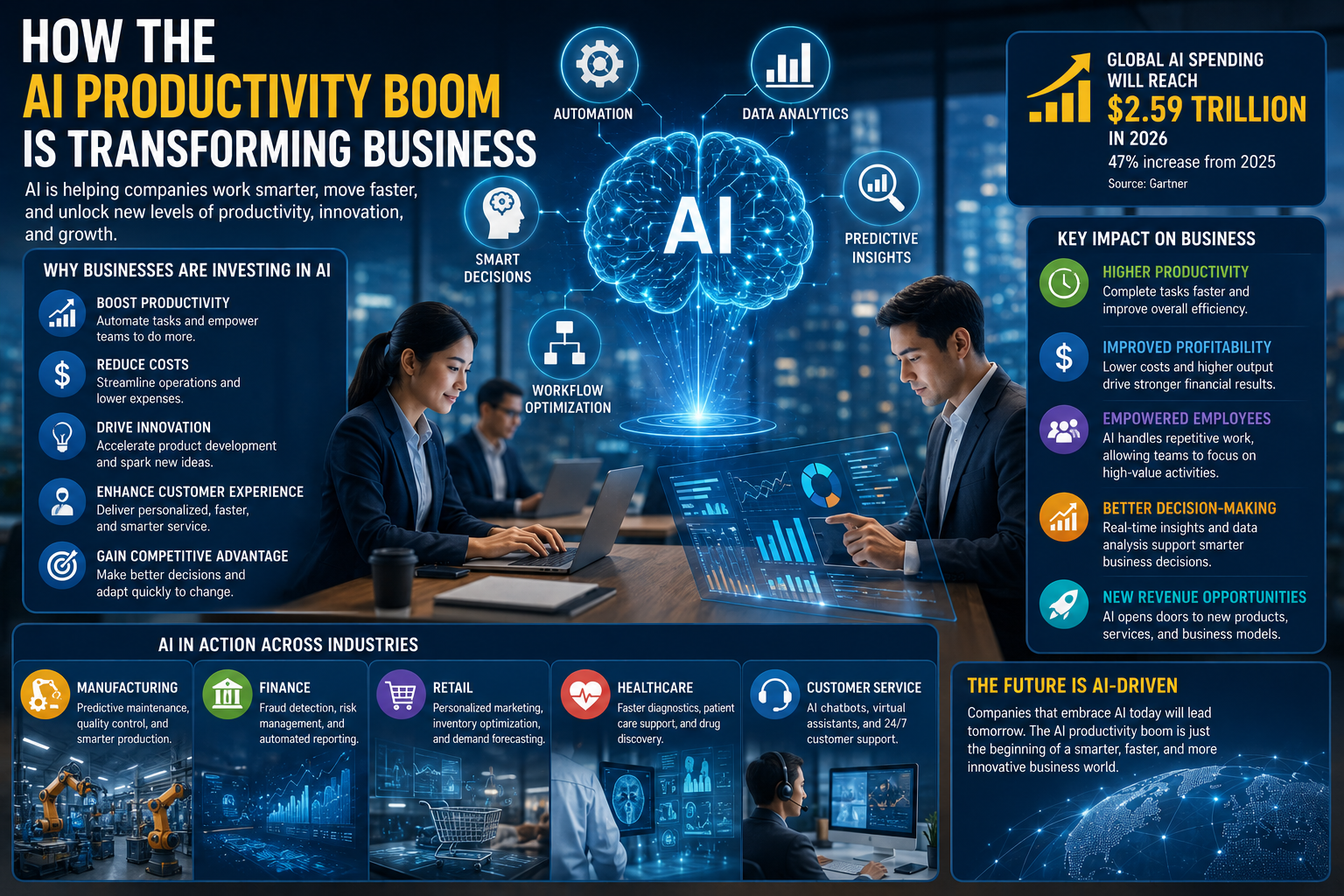
How the AI Productivity Boom Is Transforming Business – Artificial intelligence has moved beyond being a promising technology and become one of the most powerful drivers of business transformation in 2026. Across industries, companies are using AI to automate routine tasks, improve decision-making, enhance customer experiences, and increase productivity at a scale that was difficult to imagine only a few years ago.
Executives, investors, and policymakers increasingly view AI as a key source of future economic growth. Businesses are investing billions of dollars in AI infrastructure, software, data centers, and workforce training as they seek to gain a competitive advantage in a rapidly evolving marketplace. Global AI spending is expected to reach approximately $2.59 trillion in 2026, reflecting a 47% increase from the previous year.
The result is what many economists and business leaders describe as the AI productivity boom—a wave of innovation that is reshaping how organizations operate and compete.
Understanding the AI Productivity Boom
Productivity refers to the amount of output generated from a given set of inputs such as labor, capital, and technology.
Historically, major technological breakthroughs have driven significant productivity improvements. The steam engine, electricity, computers, and the internet all transformed economic activity.
Today, artificial intelligence is emerging as the next general-purpose technology capable of producing similar effects.
Unlike previous automation tools, AI can:
- Analyze massive datasets
- Generate content
- Write software code
- Support decision-making
- Improve forecasting
- Automate customer interactions
- Optimize business processes
Research shows that AI can generate productivity improvements ranging from 10% to 70% for certain tasks, particularly those involving information processing and knowledge work.
As adoption expands, these gains are beginning to influence entire industries.
Why Businesses Are Investing Heavily in AI
The race to adopt AI has accelerated dramatically.
According to Gartner, worldwide AI spending is projected to grow 47% in 2026, with infrastructure accounting for the largest share of investment. AI-optimized servers, cloud platforms, semiconductors, and computing networks are receiving enormous capital commitments from technology providers and enterprises alike.
Several factors are driving this investment surge:
Competitive Pressure
Companies fear falling behind competitors that successfully integrate AI into their operations.
Cost Reduction
Automation can reduce repetitive work and lower operating expenses.
Revenue Growth
AI enables businesses to identify new market opportunities and improve customer engagement.
Workforce Efficiency
Organizations can accomplish more without proportional increases in staffing levels.
Faster Innovation
AI accelerates research, product development, and decision-making.
These advantages explain why AI remains a top investment priority for business leaders despite economic uncertainty. A recent KPMG survey found that nearly three-quarters of global executives plan to continue prioritizing AI investment even if economic conditions deteriorate.
Transforming Workplace Productivity
One of AI’s most immediate impacts is improving workplace productivity.
Employees increasingly use AI-powered tools to:
- Draft reports
- Summarize information
- Generate marketing content
- Analyze business data
- Manage workflows
- Write software code
- Conduct research
Instead of replacing workers entirely, AI often acts as a productivity multiplier.
Employees can complete tasks more quickly and focus on higher-value activities such as strategic planning, relationship building, and creative problem-solving.
Many organizations report that AI is helping teams handle larger workloads without increasing headcount, improving both efficiency and profitability.
Recent U.S. productivity data has shown stronger-than-expected gains, with economists increasingly attributing part of this improvement to AI-related investments and technology adoption.
AI Is Reshaping Business Operations
Beyond individual productivity, AI is transforming entire business operations.
Customer Service
AI-powered chatbots and virtual assistants provide 24-hour customer support.
These systems can answer questions, resolve issues, and escalate complex cases to human representatives when necessary.
Supply Chain Management
Businesses use AI to predict demand, optimize inventory levels, and identify potential disruptions before they occur.
Financial Planning
AI helps organizations forecast revenue, manage risks, and improve budgeting accuracy.
Marketing
Companies analyze customer behavior and personalize campaigns with unprecedented precision.
Human Resources
AI assists with recruitment, employee training, workforce planning, and performance management.
As AI capabilities continue improving, organizations are integrating intelligent systems into nearly every business function.
Moving Beyond Automation
Many early AI initiatives focused primarily on automation and cost reduction.
However, leading organizations are now using AI for broader strategic transformation.
Experts increasingly argue that the greatest value of AI comes not from replacing manual tasks but from reinventing business models, improving decision-making, and creating new sources of value.
Companies are using AI to:
- Develop new products
- Enter new markets
- Improve customer experiences
- Create personalized services
- Discover revenue opportunities
- Accelerate innovation cycles
This shift from operational efficiency to strategic reinvention is becoming a defining characteristic of successful AI adoption.
The Rise of AI Leaders
Not all companies are benefiting equally from the AI boom.
Research from PwC found that approximately 20% of companies capture nearly three-quarters of AI-related economic gains. These organizations differ from their competitors in several important ways.
AI leaders are more likely to:
- Redesign workflows around AI
- Invest in workforce training
- Pursue new growth opportunities
- Reinvent business models
- Increase automated decision-making
- Establish strong governance systems
Rather than simply adding AI tools to existing processes, they fundamentally rethink how work gets done.
This approach generates greater financial returns and competitive advantages.
AI and Corporate Profitability
The AI productivity boom is having a measurable impact on corporate performance.
Companies adopting AI successfully are reporting:
- Higher profit margins
- Faster revenue growth
- Improved operational efficiency
- Better resource allocation
- Enhanced customer retention
Morgan Stanley recently identified numerous companies experiencing significant margin expansion due to AI adoption. These gains are occurring across industries including technology, finance, healthcare, industrials, and consumer services.
AI is becoming a major driver of earnings growth, helping businesses improve performance even in challenging economic environments.
The Economic Impact of AI
The AI boom extends far beyond individual companies.
Large-scale investments in data centers, cloud infrastructure, semiconductor manufacturing, and software development are contributing significantly to economic activity.
According to recent economic analysis, AI-related spending has become a major contributor to U.S. economic growth. Investments in computing infrastructure, software, and research are creating jobs, stimulating capital spending, and supporting broader economic expansion.
The economic effects include:
- Increased business investment
- Higher productivity growth
- Stronger corporate earnings
- Technology sector expansion
- Infrastructure development
These trends suggest AI may become one of the most important growth engines of the global economy during the coming decade.
Challenges and Risks
Despite its promise, the AI productivity boom is not without challenges.
Uneven Adoption
Many smaller organizations lack the resources needed to implement AI effectively.
Productivity gains often concentrate among larger and more technologically advanced companies.
Skills Gaps
Successful AI implementation requires employees with technical and analytical skills.
Many businesses face difficulties finding qualified talent.
Data Security
Organizations remain concerned about privacy, cybersecurity, and governance risks.
These concerns consistently rank among the top barriers to AI adoption.
Productivity Paradox
Although AI delivers impressive results at the task level, economists continue debating how quickly these gains will appear in broader economic productivity statistics. Some researchers argue that widespread productivity benefits may take years to materialize fully.
Workforce Disruption
AI is changing job requirements and automating certain tasks.
Organizations must manage workforce transitions carefully through training and reskilling programs.
The Future of AI-Driven Productivity
The AI productivity boom is still in its early stages.
Current adoption levels suggest enormous growth potential remains ahead. Research examining large public companies found that deep AI integration has expanded rapidly in recent years but still represents a minority of enterprises, indicating substantial room for future adoption.
Several developments are likely to shape the next phase of AI transformation:
Agentic AI
Autonomous AI systems capable of completing complex workflows are becoming increasingly common.
Advanced Decision Support
AI will play a larger role in strategic planning and business forecasting.
Industry-Specific Solutions
More specialized AI applications will emerge across healthcare, finance, manufacturing, retail, and logistics.
Human-AI Collaboration
The most successful organizations will combine human expertise with AI capabilities rather than viewing them as substitutes.
Productivity Acceleration
As adoption becomes more widespread, AI could contribute to a sustained period of higher productivity growth across the global economy.
Conclusion
The AI productivity boom is transforming business in ways that extend far beyond automation. Organizations are using artificial intelligence to improve efficiency, accelerate innovation, enhance customer experiences, optimize operations, and create entirely new growth opportunities. Massive investments in AI infrastructure, software, and workforce capabilities demonstrate that businesses view AI as a long-term strategic priority rather than a temporary trend.
While challenges remain—including uneven adoption, workforce transitions, and questions about long-term productivity measurement—the direction is clear. Companies that successfully integrate AI into their operations and business models are positioning themselves to lead the next era of economic growth. As AI capabilities continue advancing, its influence on productivity, profitability, and competitiveness is likely to become one of the defining business stories of the decade.