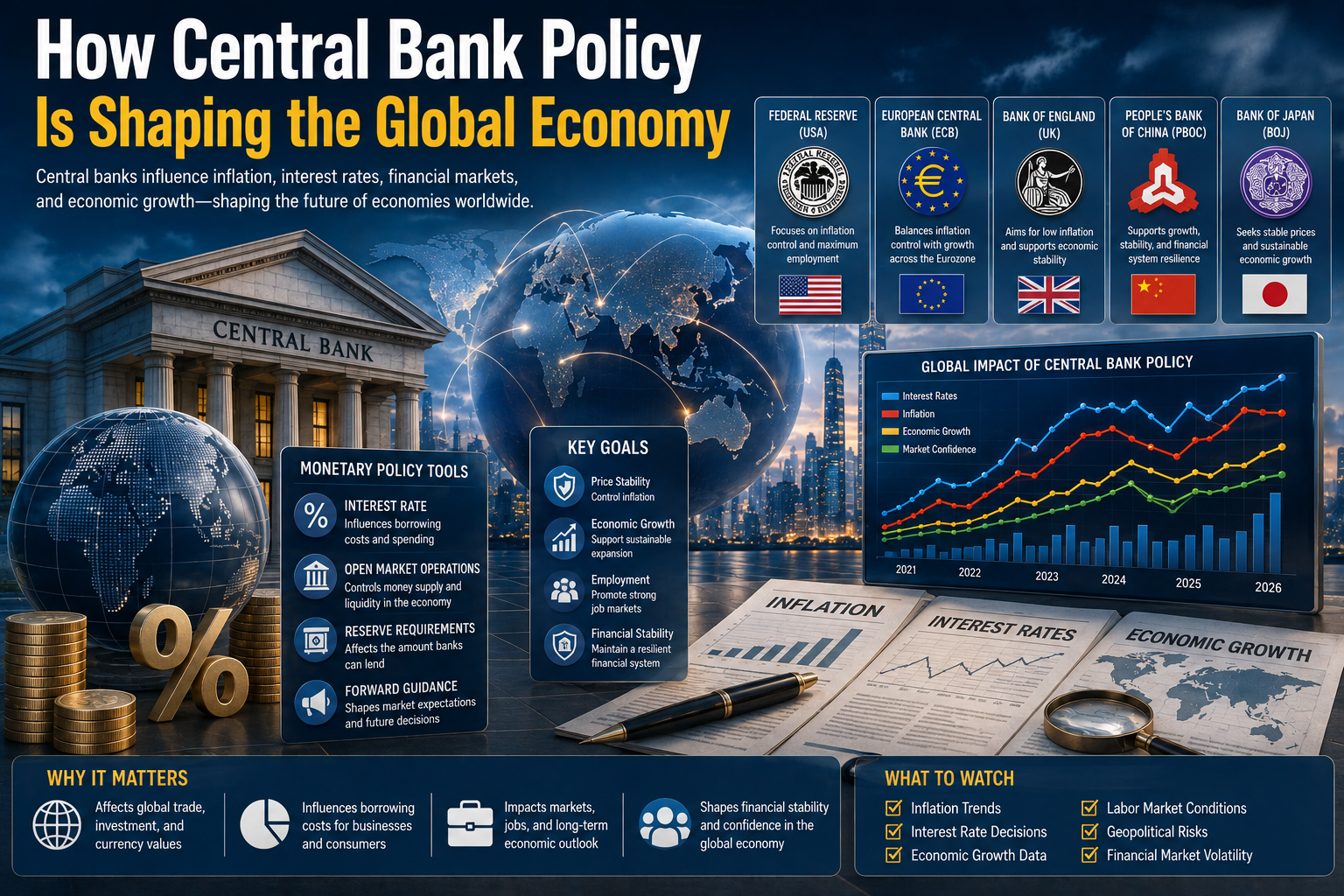
How Central Bank Policy Is Shaping the Global Economy – Central banks play a critical role in maintaining economic stability and influencing financial markets around the world. In 2026, their decisions are more important than ever as countries navigate persistent inflation, evolving economic growth patterns, geopolitical uncertainty, and rapid technological change.
Whether it is the Federal Reserve in the United States, the European Central Bank (ECB), the Bank of England, the People’s Bank of China (PBOC), or the Bank of Japan (BOJ), central banks have a significant impact on interest rates, inflation, employment, investment, and currency values.
The policies adopted by these institutions affect not only their domestic economies but also global trade, financial markets, and international capital flows. As a result, investors, businesses, and governments closely monitor central bank actions to understand where the global economy may be headed next.
What Is Central Bank Policy?
Central bank policy, often referred to as monetary policy, consists of actions taken by central banks to influence economic conditions.
The primary objectives typically include:
- Maintaining price stability
- Supporting sustainable economic growth
- Promoting employment
- Ensuring financial system stability
Central banks use several tools to achieve these goals, including:
Interest Rate Adjustments
The most widely used monetary policy tool is setting benchmark interest rates.
Higher rates generally slow borrowing and spending, helping reduce inflation.
Lower rates encourage borrowing, investment, and consumer spending, stimulating economic growth.
Open Market Operations
Central banks buy or sell government securities to influence money supply and financial conditions.
Reserve Requirements
Some central banks adjust the amount of reserves commercial banks must hold, affecting lending capacity.
Forward Guidance
Central banks communicate future policy intentions to influence market expectations and economic behavior.
These tools collectively shape financial conditions throughout the economy.
Inflation Remains the Primary Focus
One of the biggest challenges facing central banks in 2026 is inflation.
Although inflation has declined significantly from the highs experienced earlier in the decade, it remains above target levels in many economies.
Energy costs, geopolitical tensions, supply-chain disruptions, and strong consumer demand continue contributing to inflationary pressures.
As a result, many central banks remain cautious about loosening monetary policy too quickly.
The Federal Reserve, for example, has maintained a relatively restrictive stance despite slowing inflation because policymakers want to ensure price pressures remain under control.
Similarly, the European Central Bank continues balancing inflation concerns against slowing economic growth.
Controlling inflation remains essential because persistent price increases can erode purchasing power, reduce consumer confidence, and create economic instability.
Interest Rates and Economic Growth
Interest rates remain the most visible aspect of central bank policy.
When inflation rises too quickly, central banks often raise rates to cool economic activity.
Higher rates influence the economy by:
- Increasing borrowing costs
- Reducing consumer spending
- Slowing housing markets
- Lowering business investment
- Encouraging savings
Conversely, lower interest rates stimulate economic activity by making credit more affordable.
In 2026, central banks face a difficult balancing act.
Many economies continue growing, but growth has slowed compared with earlier years. Policymakers must determine whether maintaining higher rates is necessary to fight inflation or whether easing policy could help support economic expansion.
This delicate balance is one of the defining economic themes of 2026.
The Federal Reserve’s Global Influence
No central bank has greater influence on global markets than the Federal Reserve.
Because the U.S. dollar serves as the world’s primary reserve currency, Federal Reserve decisions affect economies far beyond the United States.
When the Fed raises interest rates:
- Global borrowing costs often increase.
- Capital flows toward dollar-denominated assets.
- Emerging markets may face currency pressure.
- International trade financing becomes more expensive.
When the Fed signals future rate cuts, global financial conditions often become more favorable.
Investors worldwide closely monitor Federal Reserve meetings because policy changes frequently influence stock markets, bond yields, commodities, and exchange rates.
The Fed’s actions often set the tone for monetary policy discussions across the global economy.
The European Central Bank’s Challenges
The European Central Bank faces its own unique set of challenges.
The Eurozone consists of multiple countries with different economic conditions, making policy decisions more complex than in single-country economies.
Some European nations face slower growth, while others continue experiencing stronger economic performance.
At the same time, inflation remains above the ECB’s preferred target.
As a result, the ECB must carefully balance:
- Economic growth
- Inflation control
- Financial stability
- Labor market conditions
Its policy decisions influence not only Europe but also international trade and global investment flows.
China’s Different Approach
China‘s monetary policy strategy differs significantly from many Western economies.
The People’s Bank of China often focuses on supporting growth, maintaining financial stability, and managing credit conditions.
In recent years, China has used targeted policy measures to support:
- Infrastructure investment
- Manufacturing
- Property market stabilization
- Technological development
Because China is the world’s second-largest economy, its monetary policies significantly affect global commodity demand, trade flows, and investment patterns.
Investors closely watch China’s policy decisions for signals about future economic growth and global demand trends.
Central Bank Policy and Financial Markets
Financial markets respond immediately to central bank communications.
Even subtle changes in policy language can move billions of dollars across global markets.
Stock Markets
Equity markets often benefit from expectations of lower interest rates because lower borrowing costs can support corporate earnings and investment.
Technology and growth-oriented sectors tend to be particularly sensitive to monetary policy changes.
Bond Markets
Bond yields frequently move in response to interest rate expectations.
Higher expected rates generally push yields upward, while expectations of future rate cuts can support bond prices.
Currency Markets
Exchange rates often react to differences in monetary policy between countries.
Currencies associated with higher interest rates may attract more investment capital, strengthening exchange rates.
These market reactions demonstrate the powerful influence of central bank decisions.
The Role of Central Banks in Financial Stability
Beyond managing inflation and growth, central banks are responsible for maintaining financial stability.
This responsibility includes:
- Monitoring banking systems
- Managing financial crises
- Providing emergency liquidity
- Supervising financial institutions
The global financial system has become increasingly interconnected.
Problems in one region can quickly spread to others through financial markets and banking networks.
Central banks work together through international organizations and policy coordination efforts to reduce systemic risks.
Their ability to respond during periods of market stress remains a crucial component of global economic stability.
Digital Currencies and Modern Monetary Policy
Technology is creating new challenges and opportunities for central banks.
Many institutions are exploring Central Bank Digital Currencies (CBDCs), which could transform payment systems and monetary policy implementation.
Potential benefits include:
- Faster transactions
- Improved financial inclusion
- Greater payment efficiency
- Enhanced policy transmission
At the same time, central banks must address concerns regarding privacy, cybersecurity, and financial system risks.
As digital finance continues evolving, monetary policy frameworks may also change significantly.
The intersection of technology and central banking is likely to become increasingly important during the coming decade.
Challenges Facing Central Banks in 2026
Several challenges are shaping monetary policy decisions this year.
Persistent Inflation
Inflation remains above target levels in many economies.
Geopolitical Tensions
Conflicts and trade disputes continue creating uncertainty for policymakers.
High Government Debt
Elevated public debt levels may complicate future policy decisions.
Slower Global Growth
Many economies are growing more slowly than historical averages.
Technological Disruption
Artificial intelligence and automation are transforming labor markets and productivity patterns.
These challenges require policymakers to remain flexible and data-driven.
What Businesses and Investors Should Watch
Businesses and investors should monitor several indicators that influence central bank decisions:
- Inflation reports
- Employment data
- GDP growth figures
- Consumer spending trends
- Wage growth
- Energy prices
- Financial market conditions
Changes in these indicators often provide early clues regarding future policy actions.
Understanding central bank priorities can help businesses make investment, hiring, and expansion decisions more effectively.
Similarly, investors can better manage risk by staying informed about monetary policy developments.
Conclusion
Central bank policy remains one of the most powerful forces shaping the global economy in 2026. Through interest rate decisions, inflation management, financial stability measures, and market guidance, central banks influence nearly every aspect of economic activity. The Federal Reserve, European Central Bank, People’s Bank of China, and other major institutions continue navigating a challenging environment characterized by persistent inflation, moderate growth, geopolitical uncertainty, and technological transformation.
As the global economy evolves, central bank decisions will continue affecting markets, businesses, consumers, and governments around the world. For investors and policymakers alike, understanding how monetary policy shapes economic outcomes is essential for navigating the opportunities and risks that lie ahead.