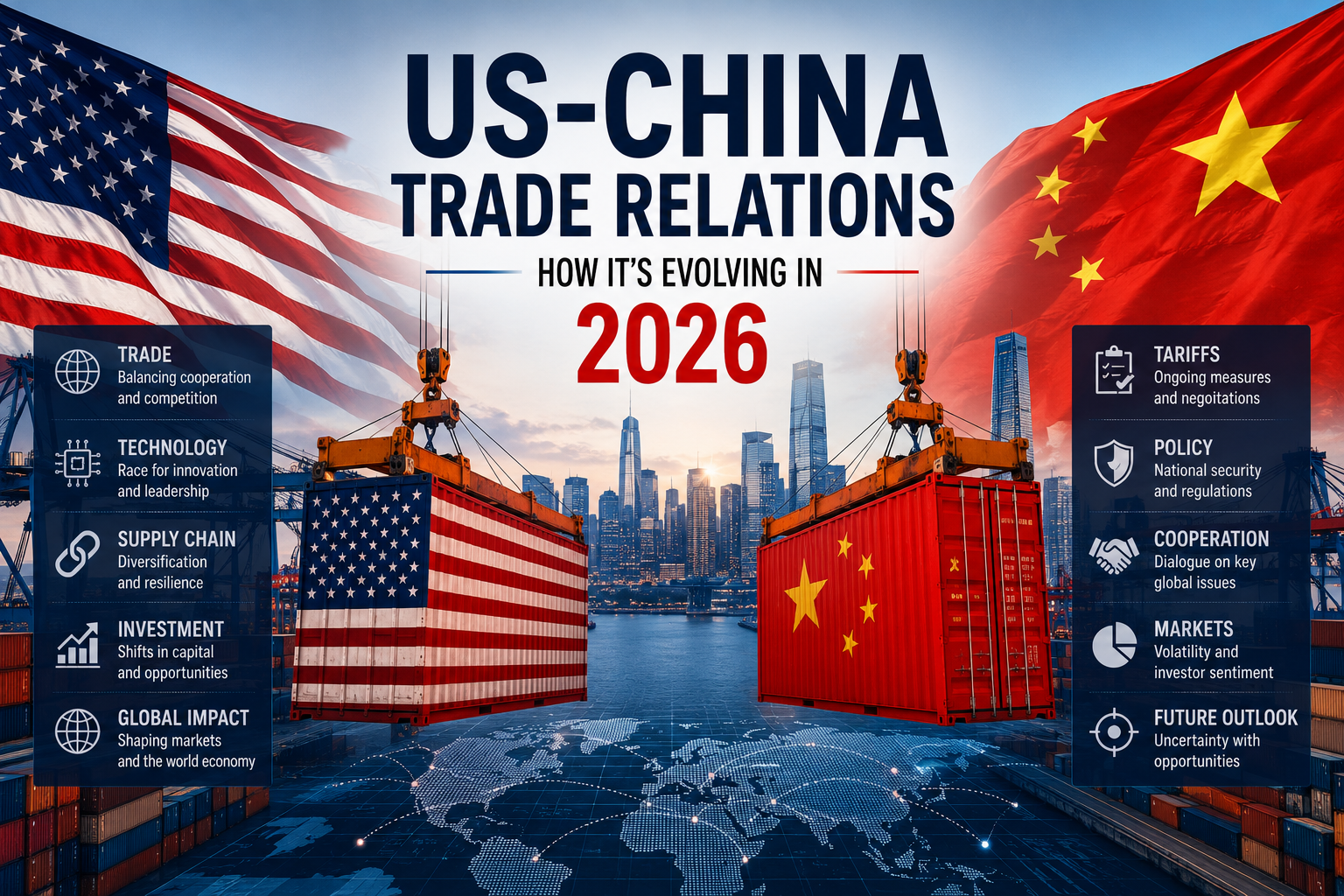
How US-China Trade Relations Are Evolving in 2026 – The relationship between the United States and China remains one of the most important forces shaping the global economy in 2026. As the world’s two largest economies, their trade policies influence international supply chains, financial markets, technology development, manufacturing, and global investment flows.
Over the past decade, US-China trade relations have experienced periods of cooperation, conflict, and negotiation. Trade disputes, tariffs, technology restrictions, and geopolitical competition have repeatedly created uncertainty for businesses and investors worldwide. Yet despite ongoing tensions, economic ties between the two countries remain deeply interconnected.
In 2026, the relationship is entering a new phase. Both nations are seeking greater economic stability while continuing to compete in strategic industries such as artificial intelligence, semiconductors, advanced manufacturing, and critical minerals. The result is a complex mix of cooperation and rivalry that continues to reshape global trade.
The Current State of US-China Trade Relations
US-China trade relations in 2026 can best be described as a relationship of cautious engagement.
Although significant disagreements remain, both governments have shown interest in maintaining communication channels and preventing trade disputes from escalating into broader economic conflicts. Recent high-level discussions between officials from both countries have focused on preserving economic stability and exploring opportunities for future agreements.
At the same time, many of the trade barriers introduced during previous years remain in place. Tariffs, export controls, and restrictions on sensitive technologies continue to influence business decisions and cross-border trade.
This dual approach—cooperation in some areas and competition in others—is defining the evolution of the relationship in 2026.
The Legacy of the Trade War
The modern trade dispute between the United States and China began in 2018 when tariffs were imposed on hundreds of billions of dollars worth of goods.
Since then, multiple administrations have maintained or expanded various trade measures. While some tariff exclusions have been extended and certain agreements have eased tensions, many trade restrictions remain active today.
Businesses have spent years adapting to this environment by:
- Diversifying supply chains
- Expanding production in other countries
- Reducing dependence on single markets
- Investing in trade compliance systems
- Increasing inventory resilience
The experience has fundamentally changed how multinational corporations approach global trade strategy.
Tariffs Continue to Play a Major Role
Tariffs remain one of the most visible aspects of US-China trade relations.
While both sides have occasionally reduced certain trade barriers through negotiation, tariff policies continue to influence the cost of imported goods and global supply chain decisions. Recent US trade actions indicate that tariffs remain a central tool of economic policy, particularly in sectors involving manufacturing, technology, and strategic industries. (Reuters)
For businesses, tariffs create both challenges and opportunities. Some companies face higher costs, while others benefit from shifts in sourcing and production.
The long-term impact has been a gradual restructuring of international trade networks.
Technology Competition Is Intensifying
Perhaps the most important area of competition in 2026 is technology.
The United States and China are competing for leadership in:
- Artificial intelligence
- Advanced semiconductors
- Cloud computing
- Quantum technology
- Telecommunications
- Advanced manufacturing
Technology restrictions have become a major component of trade policy. Export controls on advanced chips and AI-related technologies continue to shape investment decisions and corporate strategies. (arXiv)
Supporters argue that these measures protect national security interests. Critics suggest that restrictions may accelerate domestic innovation efforts within China and encourage technological self-sufficiency. (arXiv)
As a result, the competition is evolving from a traditional trade dispute into a broader contest for technological leadership.
Supply Chains Are Being Reshaped
One of the most significant consequences of evolving US-China trade relations is the transformation of global supply chains.
Companies are increasingly pursuing strategies such as:
Nearshoring
Moving production closer to key consumer markets.
Friend-Shoring
Expanding manufacturing within politically aligned countries.
Supply Chain Diversification
Reducing dependence on a single country for critical components.
Countries such as Vietnam, India, Mexico, and Indonesia have attracted increased investment as companies seek alternative production locations.
However, complete economic separation remains unlikely. China continues to play a crucial role in global manufacturing, logistics, and industrial production. Many multinational companies still depend heavily on Chinese suppliers and consumers.
Instead of full decoupling, businesses are adapting through selective diversification.
Rare Earth Minerals and Strategic Resources
Another important issue in 2026 is access to critical minerals and rare earth elements.
These materials are essential for:
- Electric vehicles
- Renewable energy systems
- Semiconductors
- Defense technologies
- Consumer electronics
China remains a dominant player in rare earth processing and supply chains. Access to these resources has become an increasingly important component of trade negotiations and industrial policy.
Both countries are investing heavily in securing supply chains for critical minerals, recognizing their importance for future economic competitiveness.
Areas of Cooperation Are Emerging
Despite ongoing competition, cooperation remains possible in several areas.
Recent discussions between leaders and senior officials have produced agreements aimed at stabilizing economic relations and improving communication. New mechanisms for trade and investment dialogue have also been established to address bilateral concerns more systematically.
Potential areas of cooperation include:
Agriculture
China remains a major market for agricultural imports from the United States.
Aviation
Commercial aircraft purchases continue to play an important role in bilateral trade agreements.
Supply Chain Stability
Both countries have incentives to avoid major disruptions that could harm global economic growth.
Climate and Energy
Long-term cooperation on clean energy technologies may create opportunities despite broader geopolitical competition.
These areas demonstrate that economic engagement continues even amid strategic rivalry.
The Impact on Global Markets
US-China trade relations influence virtually every major financial market.
Investors closely monitor developments because trade policies can affect:
- Stock market performance
- Commodity prices
- Currency movements
- Manufacturing activity
- Technology investment
- Global economic growth
Positive developments often improve investor confidence, while renewed tensions can increase volatility.
Global businesses must continuously evaluate how policy changes may affect operations, sourcing strategies, and future investments.
Challenges Ahead
Several challenges could complicate the relationship in the coming years.
Technology Restrictions
Export controls and investment screening measures are likely to remain contentious.
National Security Concerns
Economic policies are increasingly linked to strategic and security objectives.
Industrial Competition
Both countries are investing heavily in advanced industries and domestic manufacturing capabilities.
Political Uncertainty
Changes in political priorities or geopolitical events could influence future negotiations.
Managing these challenges will require ongoing dialogue and careful policy coordination.
What Businesses Should Expect
Businesses operating internationally should prepare for continued complexity in US-China trade relations.
Key trends likely to continue include:
- Ongoing supply chain diversification
- Increased compliance requirements
- Strategic technology restrictions
- Greater focus on resilience
- Regionalization of manufacturing networks
Companies that remain flexible and adaptable will be better positioned to navigate changing trade conditions.
Rather than expecting a return to pre-trade-war conditions, businesses should prepare for a world where economic competition and strategic cooperation coexist.
Conclusion
US-China trade relations in 2026 are evolving into a more structured but still highly competitive relationship. While both countries continue to cooperate in selected areas such as trade dialogue, agriculture, and investment, significant tensions remain regarding tariffs, technology, supply chains, and national security.
The relationship is no longer defined solely by trade balances and tariffs. It now encompasses technological leadership, critical minerals, industrial policy, and global economic influence.
For businesses, investors, and policymakers, understanding this evolving dynamic is essential. The decisions made by Washington and Beijing will continue to shape global markets, economic growth, and international trade for years to come. As 2026 progresses, the challenge for both nations will be finding ways to compete strategically while maintaining the economic stability that the global economy depends upon.