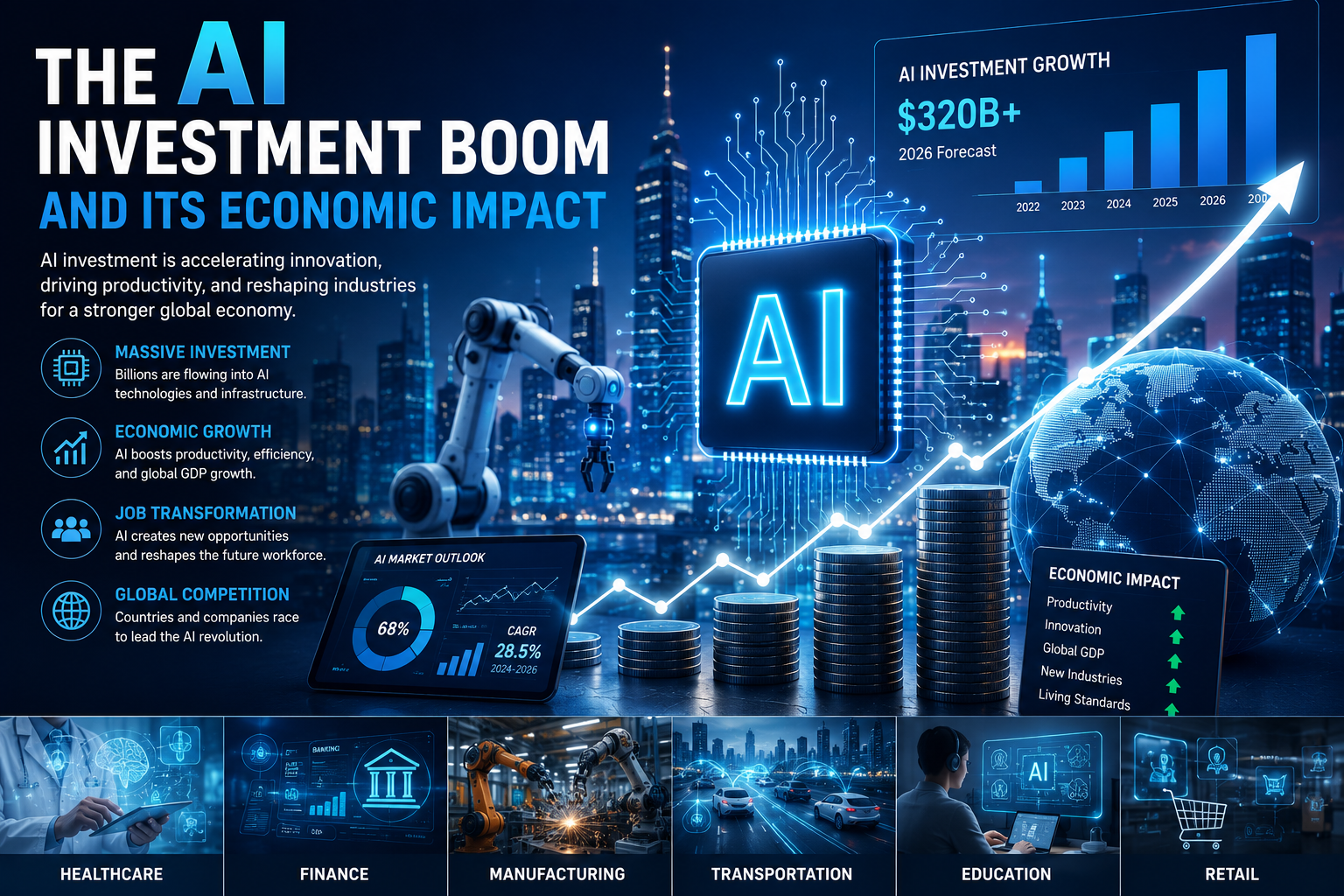
The AI Investment Boom and Its Economic Impact – The rapid ascent of artificial intelligence (AI) as a pivotal focal point for venture capital and investment represents a significant trend in the 21st century. Over recent years, the AI investment boom has garnered substantial attention, attributed to various factors that have collectively facilitated its growth. One of the primary catalysts has been the remarkable advancements in technology related to machine learning, natural language processing, and data analytics. These breakthroughs enable businesses to leverage AI for enhancing efficiency and streamlining operations.
Moreover, there is an increasing demand for AI solutions across diverse sectors, including healthcare, finance, transportation, and manufacturing. Organizations are recognizing the potential of AI to transform their processes, resulting in heightened operational effectiveness and improved decision-making capabilities. This growing interest translates into lucrative opportunities for investors seeking to capitalize on innovative startups and technology-driven initiatives. The desire for competitive advantage in a rapidly evolving marketplace is driving many companies and investors to allocate resources towards AI-driven ventures.
Notable milestones in AI research, such as breakthroughs in deep learning and neural networks, have also contributed significantly to this momentum. Achievements like the development of self-learning algorithms and advanced predictive analytics models have demonstrated tangible benefits that further fuel optimism about AI’s potential impact. Key players in this investment landscape include established technology giants, venture capital firms, and emerging startups. Their collaboration opens new avenues for funding and innovation, emphasizing the symbiotic relationship between investment and technological advancement in the AI sector.
Ultimately, the combination of technological advancements, growing sector-specific demand, and landmark achievements in AI research illustrates the multifaceted nature of the AI investment boom and the excitement it has generated among stakeholders across the globe.
Economic Implications of Increased AI Investments
The recent surge in artificial intelligence (AI) investments has the potential to reshape various aspects of the global economy. One critical area influenced by enhanced funding in AI research and development is job creation. As companies integrate AI technologies to improve efficiencies and streamline operations, new roles emerge within the AI ecosystem. These roles might include AI specialists, data scientists, and ethicists, who are crucial in addressing the complexities that accompany these advanced technologies. Furthermore, as AI applications expand into different industries, such as healthcare, finance, and agriculture, new job opportunities will arise, transforming the employment landscape.
Moreover, the infusion of capital into AI can drive innovation, leading to breakthroughs that can significantly boost productivity. Organizations that leverage AI effectively can optimize business processes, enhance decision-making, and reduce costs. This increased efficiency can contribute to overall economic growth as businesses are able to deliver products and services to consumers more swiftly and effectively. With AI’s ability to process vast amounts of data, companies can identify trends and opportunities, fostering an environment conducive to innovation and technological advancements.
However, the rapid integration of AI into the economy does not come without challenges. A notable risk associated with this surge in AI investments is workforce displacement. As automation becomes more prevalent, certain job roles may become redundant, necessitating an urgent need for reskilling and upskilling within the workforce. Furthermore, ethical considerations surrounding AI’s use in decision-making processes raise significant concerns, particularly regarding bias and fairness. Developing frameworks that ensure responsible AI deployment is paramount. Addressing these challenges is essential to harnessing the full economic potential of AI investments while safeguarding societal interests.
Sector-Specific Impacts of AI Investments
The advent of artificial intelligence (AI) has heralded a new era of innovation that significantly impacts various sectors of the economy. Each sector experiences unique transformations, driven by AI investments that streamline processes, enhance productivity, and improve decision-making.
In the healthcare sector, AI technologies are revolutionizing patient care by facilitating predictive analytics, personalized medicine, and efficient pharmaceutical research. For instance, machine learning algorithms can analyze vast datasets, identifying patterns that enable earlier diagnoses and improved treatment plans. According to industry experts, AI could reduce healthcare costs by approximately 20% while improving patient outcomes, thus fostering economic growth in this critical sector.
Finance is another domain undergoing significant changes due to AI investments. The integration of AI in applications such as algorithmic trading, fraud detection, and customer service optimization allows financial institutions to operate with remarkable efficiency. Automated systems can process countless transactions in real-time, analyzing market trends to inform investment strategies. Analysts predict that AI could add up to $1 trillion in value to the global banking sector by 2030, underscoring the profound economic implications of these advancements.
The manufacturing industry is also experiencing a seismic shift, with AI-driven automation enhancing production lines and supply chain logistics. Smart factories equipped with AI systems can dynamically adjust operations to meet fluctuating demands, minimizing waste and maximizing productivity. As reported in recent studies, the adoption of AI in manufacturing could lead to a productivity increase of up to 30%, consequently driving economic output.
Lastly, the retail sector leverages AI to personalize customer experiences and optimize inventory management. AI analyzes consumer behavior to tailor marketing strategies and predict purchasing trends. Experts believe that by embracing AI technologies, retail companies can enhance customer satisfaction and increase sales, ultimately contributing to economic growth.
In conclusion, AI investments are poised to drive transformative changes across various sectors, each bringing its unique set of challenges and opportunities. As these advancements unfold, their cumulative impact on the economy will likely be substantial.
The Future of AI Investment and Economic Growth
The future of AI investment promises to significantly shape economic growth as technological advancements continue to evolve. Emerging trends indicate that industries across various sectors are likely to further integrate AI capabilities, enhancing operational efficiencies and fostering innovation. Key areas poised for investment include healthcare, finance, transportation, and manufacturing, where AI can streamline processes, improve decision-making, and drive cost reductions.
Investors are increasingly looking at AI startups and established tech companies that are pioneering new applications of machine learning and data analytics. With the global market for AI projected to reach substantial figures in the coming years, this sector offers a fertile ground for investment opportunities. Such growth can stimulate job creation, as demand for skilled professionals in AI-related fields is expected to rise. Furthermore, by adopting AI solutions, companies can achieve long-term sustainable growth, bolstering the economy at a macro level.
However, the implications of government policy and regulation will play a pivotal role in shaping the future investment landscape. As AI technologies advance, governments worldwide are tasked with creating frameworks that encourage innovation while safeguarding public interests. Public perception surrounding AI also influences investor confidence; initiatives emphasizing the ethical use of AI and its transparent application will likely promote a conducive environment for investments.
Over the next few years, we anticipate a dynamic shift in how businesses utilize AI technologies. Those who embrace this change will benefit from a competitive edge, driving not just their growth but also contributing to the overall economic landscape. As we look to the future, the intersection of AI investment and economic growth is set to redefine traditional boundaries and usher in a new era of technological integration.