Global Economic Forecast 2026: Risks and Opportunities – The global economy enters 2026 at a pivotal moment. After years of navigating inflation shocks, supply chain disruptions, geopolitical tensions, and rapid technological transformation, governments, businesses, and investors are facing a new set of opportunities and challenges. While economic growth remains positive in most regions, uncertainty continues to shape the outlook.
According to the International Monetary Fund (IMF), global growth is expected to remain around 3.0%–3.2% in 2026, supported by technological innovation, resilient labor markets, and continued investment in artificial intelligence. However, geopolitical conflicts, energy market volatility, and high public debt levels remain significant risks.
This article explores the key factors influencing the global economic forecast for 2026 and highlights the risks and opportunities that investors and businesses should watch closely.
The State of the Global Economic Forecast in 2026
Despite numerous headwinds, the world economy has demonstrated remarkable resilience. Advanced economies have largely avoided deep recessions, while many emerging markets continue to post stronger growth rates than their developed counterparts.
The IMF projects global growth around 3.0% in 2026, while the OECD expects growth slightly below that level due to geopolitical and energy-related pressures. Although these figures are lower than the long-term average experienced before the pandemic, they suggest continued expansion rather than contraction.
Several factors are supporting growth:
- Increased investment in AI and digital infrastructure
- Strong consumer spending in major economies
- Continued business innovation
- Gradual easing of monetary policy in some regions
- Expansion in emerging markets, particularly Asia
At the same time, economic growth remains uneven across countries and industries.
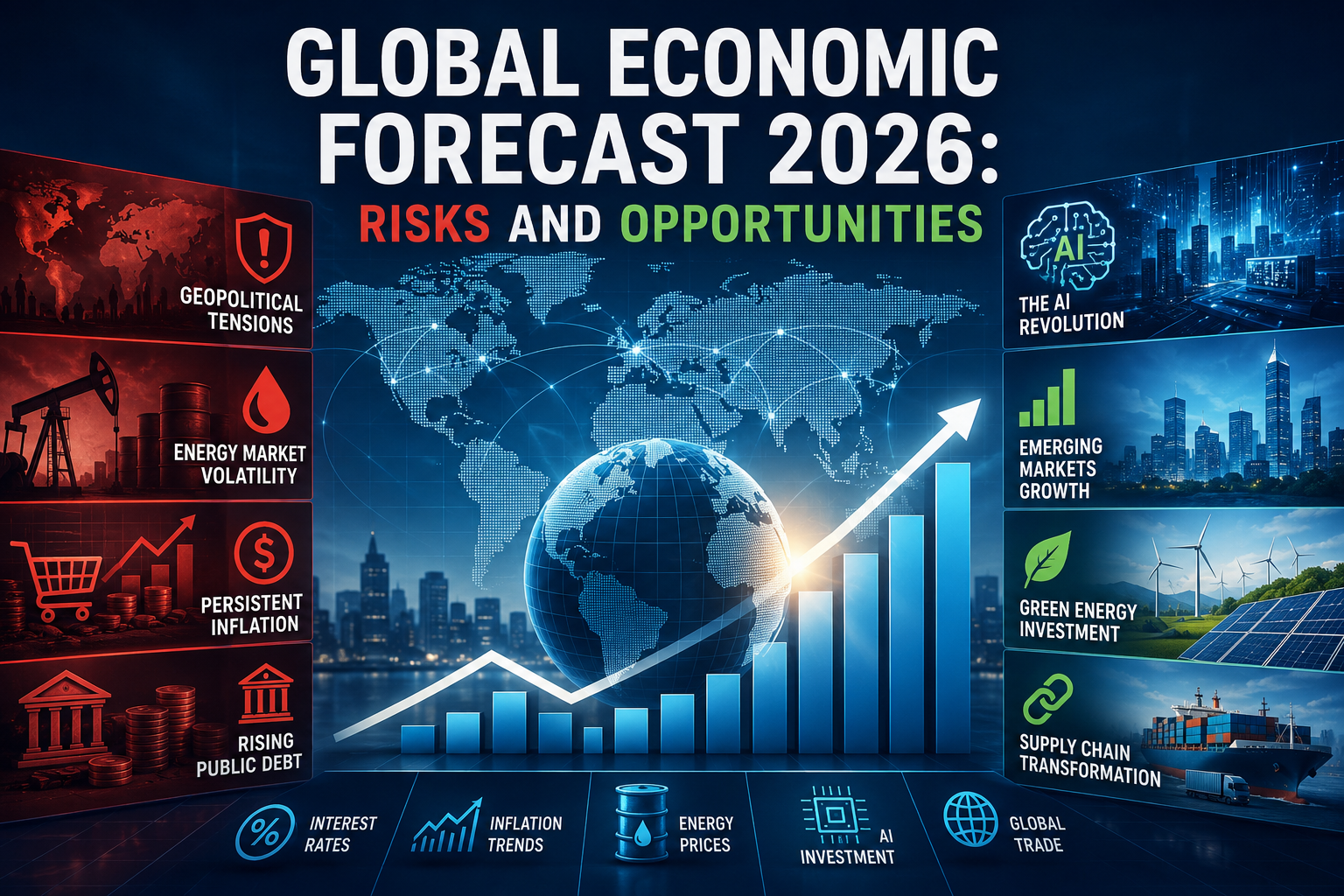
Risk #1: Geopolitical Tensions
One of the biggest threats to global growth in 2026 is geopolitical instability.
Conflicts in key regions have increased uncertainty for businesses and financial markets. Economic institutions warn that prolonged geopolitical tensions could disrupt trade routes, increase transportation costs, and reduce business investment.
The Middle East remains a major concern because of its influence on global energy supplies. Analysts warn that an escalation of regional conflicts could significantly reduce global growth while increasing inflationary pressures worldwide.
Beyond military conflicts, trade disputes between major economies continue to create uncertainty. Tariffs, export restrictions, and strategic competition are forcing companies to rethink supply chains and production strategies.
For businesses, geopolitical risk management is becoming as important as financial planning.
Risk #2: Energy Market Volatility
Energy prices remain a critical driver of global economic performance.
Oil and natural gas markets experienced significant fluctuations throughout 2025 and into 2026. Supply disruptions and transportation bottlenecks have created concerns about future energy security.
Recent forecasts indicate that disruptions in major shipping routes and oil-producing regions could tighten global energy supplies and increase costs for consumers and businesses alike.
Higher energy prices affect nearly every sector of the economy, including:
- Manufacturing
- Transportation
- Agriculture
- Logistics
- Consumer goods
If energy costs continue rising, inflation may remain higher than central banks would prefer, potentially delaying interest rate cuts.
Risk #3: Persistent Inflation
Although inflation has fallen significantly from the highs seen earlier in the decade, the fight against rising prices is not yet over.
Global disinflation has slowed in 2026, and many central banks remain cautious about loosening monetary policy too quickly. The IMF notes that inflation pressures have not completely disappeared, particularly in economies affected by energy shocks and supply constraints.
Persistent inflation creates several challenges:
- Reduced consumer purchasing power
- Higher borrowing costs
- Increased business expenses
- Lower profit margins
Central banks must carefully balance economic growth with price stability. Any policy mistakes could either reignite inflation or unnecessarily slow economic activity.
Risk #4: Rising Public Debt
Government debt levels remain elevated across many advanced and developing economies.
During recent crises, governments increased spending to support households, businesses, and infrastructure projects. While these measures helped stabilize economies, they also expanded fiscal deficits.
The IMF continues to emphasize the importance of rebuilding fiscal buffers and maintaining sustainable debt levels. Countries with large debt burdens may face higher financing costs if interest rates remain elevated for an extended period.
Debt-related concerns are particularly important for developing nations, where external financing conditions can quickly change during periods of market stress.
Opportunity #1: The AI Revolution
Artificial intelligence is rapidly becoming one of the most important drivers of global economic growth.
Companies around the world are investing billions of dollars in AI infrastructure, software, automation, and advanced computing systems. These investments are improving productivity, reducing costs, and creating entirely new industries.
The IMF highlights technology investment as a major factor supporting global growth despite broader economic challenges. AI-driven demand is especially benefiting countries integrated into technology supply chains.
Potential benefits include:
- Increased workforce productivity
- Faster innovation cycles
- Improved healthcare outcomes
- Enhanced manufacturing efficiency
- Better customer experiences
Many economists believe AI could become the most significant productivity catalyst since the internet revolution.
Opportunity #2: Emerging Markets Growth Global Economic Forecast
Emerging markets continue to offer some of the strongest growth opportunities in the global economy.
Countries across Asia, Latin America, and parts of Africa are benefiting from:
- Expanding middle-class populations
- Urbanization
- Digital adoption
- Infrastructure investment
- Growing consumer demand
India, in particular, remains one of the fastest-growing major economies in the world. Strong domestic demand and investment continue to support its long-term growth prospects.
Investors increasingly view emerging markets as attractive destinations for capital, especially in technology, renewable energy, financial services, and consumer sectors.
Opportunity #3: Green Energy Investment
The global transition toward cleaner energy continues to accelerate.
Governments and corporations are investing heavily in:
- Solar power
- Wind energy
- Battery storage
- Electric vehicles
- Hydrogen technologies
- Energy-efficient infrastructure
These investments are creating jobs, driving innovation, and opening new opportunities for businesses worldwide.
While fossil fuels remain important to the global energy mix, the long-term trend toward decarbonization is expected to continue throughout the decade.
Companies positioned within the green economy could benefit significantly from supportive policies and growing investor demand.
Opportunity #4: Supply Chain Transformation
The disruptions of recent years have encouraged businesses to build more resilient supply chains.
Many companies are diversifying production locations, investing in automation, and adopting advanced logistics technologies.
This transformation is creating opportunities in:
- Manufacturing
- Warehousing
- Robotics
- Transportation technology
- Industrial real estate
Nearshoring and regionalization strategies are helping businesses reduce dependence on single-country supply chains while improving operational resilience.
What Investors Should Watch
For investors, 2026 presents a complex environment that requires careful analysis.
Key indicators to monitor include:
Interest Rates
Central bank decisions will continue to influence stock markets, bonds, and business investment.
Inflation Trends
Persistent inflation could affect corporate earnings and consumer spending.
Energy Prices
Oil and gas markets remain highly sensitive to geopolitical developments.
AI Investment
Technology spending is likely to remain one of the strongest drivers of market growth.
Global Trade
Changes in tariffs and trade policies could create both winners and losers across industries.
Diversification remains essential as markets navigate uncertainty.
Conclusion Global Economic Forecast
The global economic forecast for 2026 presents a balanced picture of resilience and risk. Economic growth is expected to continue, supported by technological innovation, AI investment, and strong activity in emerging markets. However, challenges such as geopolitical conflicts, energy volatility, inflation pressures, and rising debt levels cannot be ignored.
For businesses, the ability to adapt to changing conditions will be crucial. For investors, identifying long-term trends rather than reacting to short-term volatility may provide the greatest opportunities.
While uncertainty remains a defining feature of the global economy, 2026 also offers significant potential for growth, innovation, and transformation. Organizations that embrace technological change, manage risks effectively, and maintain strategic flexibility will be best positioned to succeed in the years ahead.