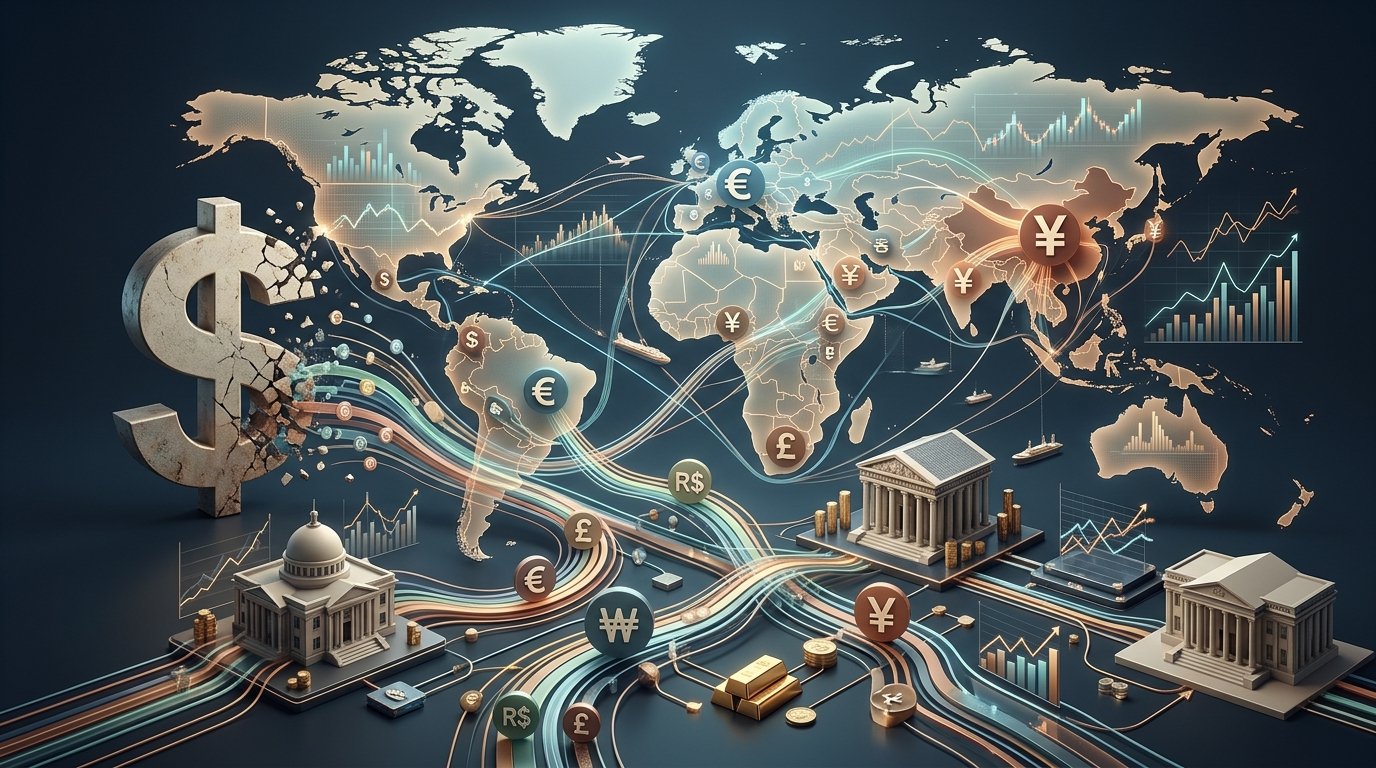
De-Dollarization and the Future of Global Finance – De-dollarization has become one of the most discussed trends in the global economy. For decades, the U.S. dollar has stood at the center of international finance, serving as the dominant reserve currency, a major trade invoicing currency, and the primary medium for cross-border financial transactions. However, growing geopolitical tensions, changing trade relationships, technological developments, and efforts by emerging economies to diversify their financial systems are raising questions about how long this dominance can continue.
De-dollarization does not necessarily mean that the U.S. dollar will suddenly lose its global position. Instead, it describes a gradual effort by governments, businesses, and financial institutions to reduce their dependence on the dollar by using other currencies, increasing gold holdings, developing alternative payment systems, and diversifying foreign exchange reserves.
The future of global finance may therefore be less about replacing the dollar and more about creating a more diversified and multipolar monetary system.
Understanding De-Dollarization
De-dollarization refers to the process of reducing the role of the U.S. dollar in international economic and financial activities. This can occur in several ways. Central banks may reduce the percentage of their foreign exchange reserves held in dollars. Countries may use local currencies when trading with international partners. Businesses may invoice exports and imports in currencies other than the dollar. Governments may also develop alternative payment networks that reduce reliance on dollar-based financial infrastructure.
The concept has gained attention because the dollar’s international role gives the United States significant influence over global finance. U.S. monetary policy can affect borrowing costs, exchange rates, capital flows, and financial conditions far beyond American borders.
The International Monetary Fund continues to describe the dollar as the primary international currency, with a dominant role in reserves, trade invoicing, and financial transactions.
At the same time, the dollar’s dominance does not mean other currencies are irrelevant. The euro, Japanese yen, British pound, Swiss franc, Chinese renminbi, and other currencies all contribute to the diversification of the international monetary system.
The Dollar Still Dominates Global Reserves
Despite the growing discussion about de-dollarization, current data show that the dollar remains extremely important.
According to the IMF’s latest Currency Composition of Official Foreign Exchange Reserves data, the U.S. dollar accounted for 57.13% of global foreign exchange reserves in the first quarter of 2026. The figure increased from 56.42% in the previous quarter.
This is important because discussions about de-dollarization can sometimes create the impression that central banks are rapidly abandoning the dollar. The available reserve data do not support such a dramatic conclusion.
The Chinese renminbi, for example, accounted for only around 2% of global foreign exchange reserves in recent IMF data.
The euro remains the second-largest reserve currency, with a share of approximately 20%. This demonstrates that diversification is already occurring, but it is not yet equivalent to a complete transformation of the international monetary system.
The dollar’s position is supported by the enormous size and liquidity of U.S. financial markets, the depth of the Treasury market, the global use of dollar-denominated contracts, and the established infrastructure surrounding international dollar transactions.
Why Countries Are Exploring Alternatives
Several factors are encouraging governments to consider reducing their reliance on the dollar.
One major factor is geopolitical risk. Countries facing sanctions or restrictions on access to parts of the international financial system have strong incentives to develop alternative channels for trade and payments.
Another factor is monetary diversification. Central banks generally want reserves that are liquid, reliable, and capable of preserving purchasing power. Holding multiple currencies and other assets can reduce concentration risk.
Trade relationships are also changing. As emerging economies increase their share of global commerce, some governments want bilateral trade to be conducted using their domestic currencies instead of automatically converting transactions into dollars.
Technology is another important factor. Digital payment systems, central bank digital currency research, instant payment networks, and blockchain-based financial infrastructure could make cross-border transactions less dependent on traditional dollar-centered systems.
These developments do not necessarily represent hostility toward the dollar. In many cases, they are simply attempts to create greater flexibility and reduce financial vulnerability.
BRICS and the Push for Greater Currency Diversification
BRICS has become one of the most visible groups associated with de-dollarization discussions.
Countries within and around the expanded BRICS framework have explored ways to increase the use of local currencies in trade and improve cross-border payment connectivity. Recent discussions have included payment platforms and greater integration between domestic payment systems.
The objective is not necessarily to create a single BRICS currency that immediately replaces the dollar. Such a project would face enormous economic, political, and institutional challenges.
Instead, a more realistic development may involve increased use of national currencies for bilateral trade. For example, two countries could settle more transactions directly in their own currencies rather than using the dollar as an intermediary.
This approach could reduce transaction costs and dollar exposure in specific trade corridors.
However, there are significant limitations. A successful international currency requires more than political support. It needs deep financial markets, predictable institutions, strong legal protections, convertibility, liquidity, and widespread confidence.
For this reason, the rise of alternative payment systems does not automatically translate into the creation of a new global reserve currency.
The Chinese Renminbi’s Growing Role
China is central to discussions about the future of global finance because of its enormous trade volume and expanding economic influence.
The renminbi has gradually become more visible in international trade and financial transactions. China has also promoted financial infrastructure designed to facilitate cross-border renminbi payments.
However, the renminbi still faces structural obstacles before it can rival the dollar as the world’s leading reserve currency.
Capital-account restrictions, the structure of China’s financial system, concerns about transparency, and the limited international availability of renminbi-denominated assets all affect its global appeal.
The IMF’s reserve data illustrate this gap clearly. Even after years of internationalization efforts, the renminbi represented only a small fraction of global official foreign exchange reserves compared with the dollar and euro.
Therefore, the most likely scenario is not an immediate transition from dollar dominance to renminbi dominance. Instead, the renminbi may gradually become one component of a more diversified international monetary system.
Gold and the Return of Reserve Diversification
Gold is another major element of the de-dollarization discussion.
Central banks have increased attention toward gold as a reserve asset because it does not depend directly on another country’s financial system or sovereign currency.
The IMF noted that gold surpassed U.S. Treasuries as a share of official reserves in 2025, although valuation effects from higher gold prices played a major role in that development.
Gold has several advantages as a reserve asset. It has no issuer default risk, can provide diversification, and has historically maintained an important role during periods of monetary and geopolitical uncertainty.
However, gold also has limitations. It does not generate interest income like many government securities, and its price can be highly volatile.
For these reasons, gold is unlikely to completely replace currencies in central bank reserves. Instead, it may become an increasingly important part of diversified reserve strategies.
Digital Finance Could Accelerate Change
Technology could become one of the most important forces shaping de-dollarization over the next decade.
Traditional cross-border payments can involve multiple banks, currencies, intermediaries, and settlement systems. New digital infrastructure could make international transactions faster and potentially reduce dependence on established financial networks.
Central bank digital currencies are one possible development. Several countries have researched or developed digital forms of their national currencies, with the goal of improving payment efficiency and financial connectivity.
Stablecoins are another important development. Dollar-denominated stablecoins can actually reinforce the international role of the U.S. dollar because many are backed by dollar assets. At the same time, they create new channels for digital dollar circulation beyond traditional banking systems.
The IMF has warned that foreign-currency stablecoins can effectively accelerate digital dollarization in emerging markets, particularly where local currencies are volatile or institutions are weak.
This creates an interesting paradox: technological innovation could reduce reliance on traditional dollar infrastructure while simultaneously increasing the global circulation of digital dollars.
What De-Dollarization Means for Emerging Markets
Emerging economies could experience some of the biggest effects from changes in the global monetary system.
A more diversified international currency system could give emerging economies greater flexibility in trade and reserve management. Countries could potentially reduce their exposure to fluctuations in the dollar and U.S. monetary policy.
However, diversification also creates new challenges.
Using multiple currencies can increase foreign exchange risk. Businesses may need to manage more complex currency exposures, while banks must develop expertise in additional markets.
There is also the question of liquidity. The dollar remains attractive partly because it can be easily traded in enormous financial markets. Alternative currencies may not offer the same level of liquidity.
For emerging economies, the transition therefore needs to balance independence with financial stability.
What De-Dollarization Means for the United States
The United States also has significant interests at stake.
The dollar’s international status provides several advantages. Strong global demand for dollar assets supports the depth and liquidity of U.S. financial markets. It also allows the United States to borrow internationally in its own currency.
The dollar’s role also strengthens the global influence of U.S. monetary policy and financial institutions.
A substantial long-term decline in dollar usage could reduce some of these advantages. However, a gradual reduction would not necessarily create an immediate crisis for the U.S. economy.
The bigger concern would be whether confidence in U.S. institutions, fiscal sustainability, financial-market openness, or economic stability deteriorates enough to accelerate the shift.
The strength of the dollar is therefore connected not only to currency policy but also to the broader credibility of the U.S. economic and institutional system.
A Multipolar Financial System Is More Likely Than a Dollar Replacement
One of the most important points about de-dollarization is that replacing the dollar entirely would be extremely difficult.
The dollar benefits from powerful network effects. Because so many countries, companies, banks, and investors already use it, new participants have strong incentives to continue using the same currency.
A company may prefer to invoice in dollars because its suppliers use dollars. Banks may prefer dollar funding because global markets are already highly liquid. Central banks may continue holding dollars because U.S. Treasury securities are widely traded and easy to access.
This creates a self-reinforcing system.
Consequently, the future is more likely to involve a multipolar monetary environment than a sudden post-dollar world.
The dollar could remain the largest reserve and transaction currency while the euro, renminbi, yen, pound, Swiss franc, regional currencies, and gold become increasingly important components of global financial diversification.
The Future of Global Finance
The global financial system is likely to become more fragmented and diversified over the coming years.
Instead of one currency dominating almost every aspect of international finance, different currencies may become more important in different regions and economic activities.
The dollar could remain dominant in global capital markets and commodity pricing. The euro may continue to play a major role across Europe and neighboring economies. The renminbi could gain importance in China’s trade relationships. Regional currencies could become more important in bilateral commerce.
Digital payment systems may connect these currencies more efficiently than traditional financial infrastructure.
This could create a global financial system that is simultaneously more diversified and more technologically connected.
The key question is not whether the dollar will disappear. The evidence suggests that such an outcome is unlikely in the foreseeable future. The more important question is how much of the dollar’s current market share will gradually be distributed among competing currencies and alternative reserve assets.
Conclusion
De-dollarization is not a single event but a long-term transformation in the way countries manage reserves, conduct trade, make payments, and protect themselves from financial risks.
The U.S. dollar remains firmly at the center of global finance. IMF data for the first quarter of 2026 show that it still represented more than 57% of global foreign exchange reserves.
Nevertheless, the international monetary system is becoming more diversified. Central banks are paying greater attention to alternative currencies and gold, emerging economies are exploring local-currency trade, BRICS countries are discussing alternative payment infrastructure, and digital financial technologies are changing how money moves across borders.
The most realistic future is therefore not a world without the dollar. It is a world where the dollar remains the leading global currency but operates alongside a wider range of alternatives.
For businesses, investors, governments, and financial institutions, this shift means that understanding currency diversification will become increasingly important. Global finance may remain dollar-centered for years to come, but the foundations of a more multipolar financial system are already taking shape.